Guide to the galleries of mammalia (mammalian, osteological, cetacean) in the Department of Zoology of the British Museum (Natural History).
- British Museum (Natural History). Department of Zoology.
- Date:
- 1892
Licence: Public Domain Mark
Credit: Guide to the galleries of mammalia (mammalian, osteological, cetacean) in the Department of Zoology of the British Museum (Natural History). Source: Wellcome Collection.
98/142 page 86
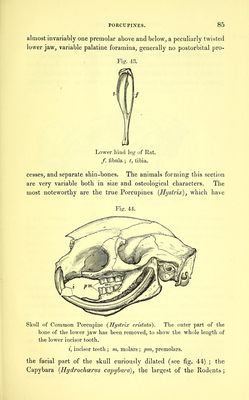
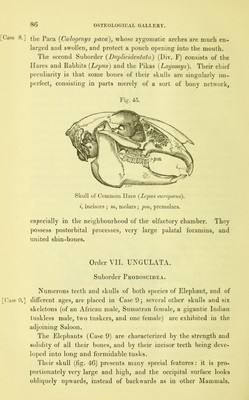
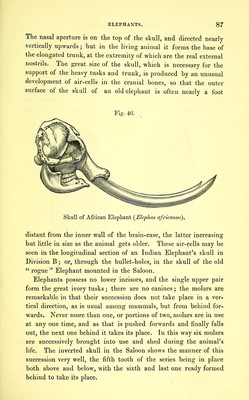
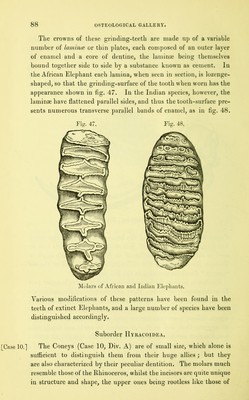
![[Case 8.] tlie I’aca [Cadogenys yacd)^ whose zygomatic arches are much en- larged and swollen, and protect a pouch opening into the mouth. The second Suborder {Dujjlkidentata) (Div. F) consists of the Hares and Rabbits [Lepus) and the Pikas (Lagomys). Their chief peculiarity is that some bones of their skulls are singularly im- perfect, consisting in parts merely of a sort of bony network, Fig. 4o, Skull of Common Hare (Lepus eiiropreus). i, incisors ; m, molars; premolars. especially in the neighbourhood of the olfactory chamber. They ])Ossess postorbital processes, very large palatal foramina, and united shin-bones. Order VII. UNGULATA. Suborder Pkoboscidea. Numerous teeth and skulls of both species of Elephant, and of [Case 0.] different ages, are jilaced in Case 9; several other skulls and six skeletons (of an African male, Sumatran female, a gigantic Indian tuskless male, two tuskers, and one lemale) are exhibited in the adjoining Saloon. The Ele})hants (Case 9) are characterized by the strength and solidity of all their bones, and by their incisor teeth being deve- lo])cd into long and formidable tusks. Their skull (fig. 46) presents many special features : it is pro- ])orlioiiatcly very large and high, and the occipital surface looks obliquely upwards, instead of backwards as in other Mammals.](https://iiif.wellcomecollection.org/image/b28122574_0098.jp2/full/800%2C/0/default.jpg)