[Report 1953] / School Medical Officer of Health, Salop / Shropshire County Council.
- Shropshire (England). County Council.
- Date:
- 1953
Licence: Attribution 4.0 International (CC BY 4.0)
Credit: [Report 1953] / School Medical Officer of Health, Salop / Shropshire County Council. Source: Wellcome Collection.
20/34 (page 18)
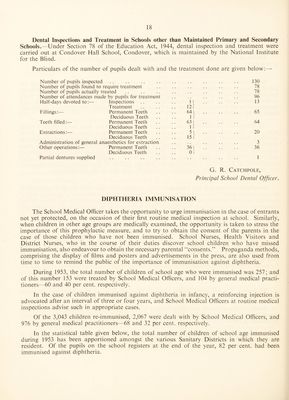
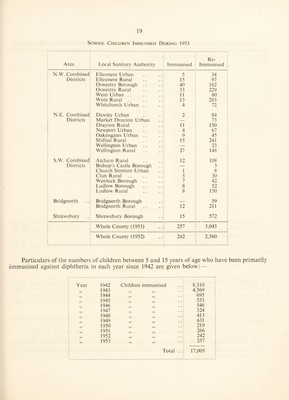
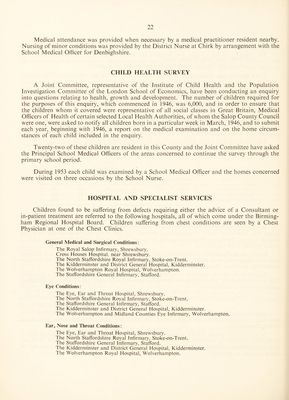
![Dental Inspections and Treatment in Schools other than Maintained Primary and Secondary Schools.—Under Section 78 of the Education Act, 1944, dental inspection and treatment were carried out at Condover Hall School, Condover, which is maintained by the National Institute for the Blind. Particulars of the number of pupils dealt with and the treatment done are given below:— Number of pupils inspected Number of pupils found to require treatment Number of pupils actually treated Number of attendances made by pupils for treatment Half-days devoted to:— Inspections Treatment Fillings:— Permanent Teeth Deciduous Teeth Teeth filled:— Permanent Teeth Deciduous Teeth Extractions:— Permanent Teeth Deciduous Teeth Administration of general anaesthetics for extraction Other operations:— Permanent Teeth Deciduous Teeth Partial dentures supplied 641 1 ) 51 15] 36) 0) 130 78 78 96 13 65 64 20 3 36 1 G. R. Catchpole, Principal School Dental Officer. DIPHTHERIA IMMUNISATION The School Medical Officer takes the opportunity to urge immunisation in the case of entrants not yet protected, on the occasion of their first routine medical inspection at school. Similarly, when children in other age groups are medically examined, the opportunity is taken to stress the importance of this prophylactic measure, and to try to obtain the consent of the parents in the case of those children who have not been immunised. School Nurses, Health Visitors and District Nurses, who in the course of their duties discover school children who have missed immunisation, also endeavour to obtain the necessary parental “consents.” Propaganda methods, comprising the display of films and posters and advertisements in the press, are also used from time to time to remind the public of the importance of immunisation against diphtheria. During 1953, the total number of children of school age who were immunised was 257; and of this number 153 were treated by School Medical Officers, and 104 by general medical practi¬ tioners—60 and 40 per cent, respectively. In the case of children immunised against diphtheria in infancy, a reinforcing injection is advocated after an interval of three or four years, and School Medical Officers at routine medical inspections advise such in appropriate cases. Of the 3,043 children re-immunised, 2,067 were dealt with by School Medical Officers, and 976 by general medical practitioners—68 and 32 per cent, respectively. In the statistical table given below, the total number of children of school age immunised during 1953 has been apportioned amongst the various Sanitary Districts in which they are resident. Of the pupils on the school registers at the end of the year, 82 per cent, had been immunised against diphtheria.](https://iiif.wellcomecollection.org/image/b30087521_0020.jp2/full/800%2C/0/default.jpg)