Experiments on the action of red Bordeaux wine (claret) on the human body / by E.A. Parkes and Cyprian Wollowicz.
- Parkes, Edmund A. (Edmund Alexander), 1819-1876.
- Date:
- 1870
Licence: Public Domain Mark
Credit: Experiments on the action of red Bordeaux wine (claret) on the human body / by E.A. Parkes and Cyprian Wollowicz. Source: Wellcome Collection.
Provider: This material has been provided by The Royal College of Surgeons of England. The original may be consulted at The Royal College of Surgeons of England.
10/18 (page 82)
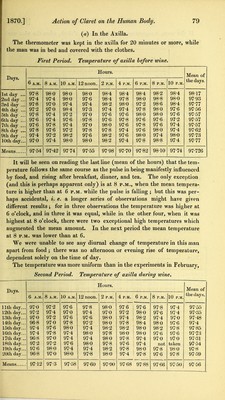
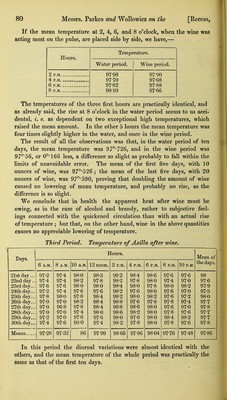
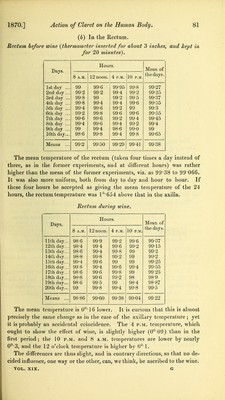
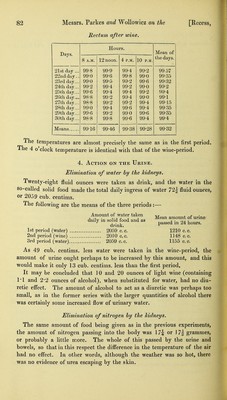
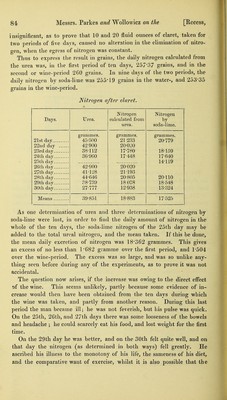
![Rectum after wine. Hours. Days. Mean of 8 A.M. noon. x P.M. 10 P.M. the days. 21st day ... 99-8 99-9 99-4 99-2 99 57 22nd day.. 99-0 99-6 99-8 99-0 99-35 zorci Clay... QQ-n vv U 99-5 99-2 vv D 24th day... 99-2 994 99-2 990 99-2 25th day... 99-6 99-4 99-4 99-2 99-4 26th day... 98-8 99-2 99-4 99-0 99-1 27th day.,. 98-8 99-2 99-2 99-4 99-15 28th day... 99-0 99-4 99-6 99-4 99-35 29th day... 99-6 99-2 99 0 99-6 99-35 30th day... 98-8 99-8 99-6 99-4 99-4 Means 99-16 99-46 99-38 99-28 99-32 The temperatures are almost precisely the same as in the first period. The 4 o'clock temperature is identical with that of the wine-period. 4. Action on the Urine. Elimination of water by the kidneys. Twenty-eight fluid ounces were taken as drink, and the water in the so-called solid food made the total daily ingress of water 72| fluid ounces, or 2059 cub. centims. The following are the means of the three periods :— Amount of water taken daily in solid food and as drink. 1st period (water) 2059 c. c. 2nd period (wine) 2010 e. e. 3rd period (water) 2059 c.c. Mean amount of urine passed in 24 hours. 1210 c. c. 1148 c.c. 1155 c. c. As 49 cub. centims. less water were taken in the wine-period, the amount of urine ought perhaps to be increased by this amount, and this would make it only 13 cub. centims. less than the first period. It may be concluded that ] 0 and 20 ounces of light wine (containing 1*1 and 22 ounces of alcohol), when substituted for water, had no diu- retic eff'ect. The amount of alcohol to act as a diuretic was perhaps too small, as in the former series with the larger quantities of alcohol there was certainly some increased flow of urinary water. Elimination of nitrogen by the kidneys. The same amount of food being given as in the previous experiments, the amount of nitrogen passing into the body was 17:|: or 1 7i grammes, or probably a little more. The whole of this passed by the urine and bowels, so that in this respect the difl'erence in the temperature of the air had no effect. In other words, although the weather was so hot, there was no evidence of urea escaping by the skin.](https://iiif.wellcomecollection.org/image/b22275939_0012.jp2/full/800%2C/0/default.jpg)