Licence: Attribution-NonCommercial 4.0 International (CC BY-NC 4.0)
Credit: The works. Source: Wellcome Collection.
Provider: This material has been provided by Royal College of Physicians, London. The original may be consulted at Royal College of Physicians, London.
33/418
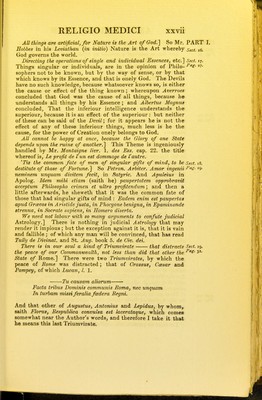
![All thing* are artificial, for Nature is the Art of God.] So Mr. PART I, Hobbes in his Leviathan {in initio) Nature is the Art whereby sect. 16. God governs the world. Directing the operations of single and individual Essences, etc.] Sed. 17. Things singular or individuals, are in the opinion of Philo- ^f- sophers not to be known, but by the way of sense, or by that which knows by its Essence, and that is onely God, The Devils have no such knowledge, because whatsoever knows so, is either the cause or effect of the thing known; whereupon Averroes concluded that God was the cause of all things, because he understands all things by his Essence; and Albertus Magnus concluded. That the inferiour intelligence understands the superiour, because it is an effect of the superiour : but neither of these can be said of the Devil; for it appears he is not the effect of any of these inferiour things, much less is he the cause, for the power of Creation onely belongs to God. All cannot be happy at once, because the Glory of one State depends upon the ruine of another.] This Theme is ingeniously handled by Mr. Montaigne livr. 1. des Ess. cap. 22. the title whereof is, Le profit de I'un est dommage de I'autre. 'Tis the common fate of men of singular gifts of mind, to be Sect. 18. destitute of those of Fortune.] So Petron. Arbiter. Amor ingenii ^'^s- neminem unquam divitem fecit, in Satyric. And Apuleius in Apolog. Idem mihi etiam (saith he) paupertatem opprobravit acceptum Philosopho crimen et ultra profitendum; and then a little afterwards, he sheweth that it was the common fate of those that had singular gifts of mind : Eadem enim est paupeHas apud GrcEcos in Ari.itide justa, in Phocyone benigna, in Epaminonde strenua, in Socrate sapiens, in Homero diserta. We need not labour with so many arguments to confute judicial Astrology.] There is nothing in judicial Astrology that may render it impious; but the exception against it is, that it is vain and fallible ; of which any man will be convinced, that has read Tully de Divinat. and St. Aug. book 5. de Civ. dei. There is in our soul a kind of Triumvirate that distracts Sect. 19. the peace of our Commonwealth, not less than did that other the 3'* State of Rome.] There were two Triumvirates, by which the peace of Rome was distracted; that of Crassus, Ceesar and Pompey, of which Lucan, I. 1. Tu causam aliorum Facta tribus Dominis communis Roma, nec unquam In turbam missi feralia foedera Regni. And that other of Augustus, Antonius and Lepidus, by whom, saith Florut, Respublica convulsa est lacerataque, which cornea somewhat near the Author's words, and therefore I take it that he means this last Triumvirate.](https://iiif.wellcomecollection.org/image/b22650349_0001_0035.jp2/full/800%2C/0/default.jpg)