Licence: Attribution-NonCommercial 4.0 International (CC BY-NC 4.0)
Credit: The works. Source: Wellcome Collection.
Provider: This material has been provided by Royal College of Physicians, London. The original may be consulted at Royal College of Physicians, London.
38/418
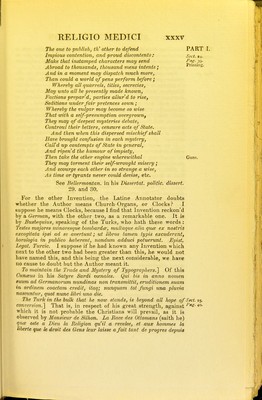
![PARTI. And cannot but co7nmend the judgment of Ptolemy,] He means Sect. 23. of PtolenuBus Philadelphus, who founded the Library of Alexandria, Pag. 37. which he speaks of in the next Section. He was King of Egypt; and havingr built and furnish'd that Library with all the choicest Books he could get from any part of the world, and having good correspondence with Eleazer the high Priest of the Jews, by reason that he had released the Jews from Captivity, who were taken by his Predecessor PtolenuBus Lagi; he did by the advice of Demetrius Phalereus the Athenian, whom he had made his Library-Keeper, write to Eleazer, desiring him that he would cause the Books of the Jews, which contained their Laws, to be translated for him into Greek, that he might have them to put into his Library : to which the Priest consents; and for the King's better satisfaction, sends to him Copies of the Books, and with the same 72 Interpreters skilled both in the Greek and Hebrew Language, to translate tihem for him into Greek ; which afterwards they performed. This is for cei-tain; but whether they translated only the Pentateuch, as St. Jerome would have it, or together with the Books of the Prophets also, as Leo de Castro and Baronius contend, I undertake not to determine: but as to that part of the story, that these Interpreters were put into so many several Cells, whilst they were about the work of translation; and notwithstanding they were thus severed, that they all translated it totidem verbis; it is but reason to think with St. Jerome (notwithstanding the great current of Authority against him) that it is no better than a fable. The Alcoran of the Turks (I speak without prejudice) is an ill- composed piece, containing in it vain and ridiculous errors in Philosophy, etc.] It is now in every mans hand, having been lately translated into English; I shall therefore observe but these few particulars in it, in regard the book it self is so common; and indeed they are not mine own, but Lipsius his observations. He begins, 0 nugas, 0 deliria! primum (saith he) commentus est, Deum unum solidumq; (6\6(T<f)vpov Graci \expri- munt) eundemq; incorporeum esse. Christum non Deum, sed magnum vatem et prophetam; se tamcn majorem, et proxime a Deo missum, prmmia qui ipsum audient Paradisum, qui post aliquot annorum millia reserahitur, ibi quatuor flumina lacte, vino, melle, aqua fluere, ibi palatia et cedificia gemmata atque aurata esse, carnes avium suavissimarum, fructus otnne genus quos sparsi jacentesque sub umbra arborum edent: sed caput feBlicitatis, viros fmminasque, majores solito mngnis Genitalibus assidua libidine, et ejus usu sine trndio aut fatigatione. These and some others that are in the Alcoran he reckons up. Sed et Physica quoq; miranda (saith he) nam facit Solem et Lunam in equis vehi, ilium autem in aquam calidam vespere mergi, et bene lotum ascendere atqu£ oriri, Stellas in aerc e catenis aureis pendere: terram in bovini cornus cuspide stabilitum, ct agitante se bove ac succutiente fieri terra](https://iiif.wellcomecollection.org/image/b22650349_0001_0040.jp2/full/800%2C/0/default.jpg)