Licence: Attribution-NonCommercial 4.0 International (CC BY-NC 4.0)
Credit: The works. Source: Wellcome Collection.
Provider: This material has been provided by Royal College of Physicians, London. The original may be consulted at Royal College of Physicians, London.
51/418
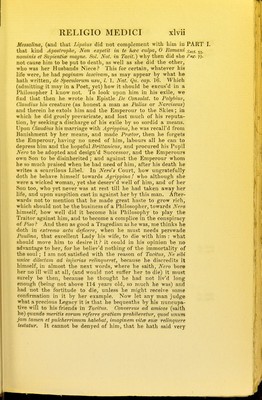
![Or whence Lucan learn'd to say. Communis mundo superest PART I. rogus, etc.] Why, Lucan was a Stoique, and 'twas an opinion sect.4s- among them almost generally, that the world should perish by -Paf. 64. lire ; therefore without doubt from them he learned it. Cesium quoque cum omnibus qute in ccelo continentur, ita ut coepisset desinere,fontium dulci aqua marisve nutriri, in vim ignis abiturum. Stoids constans opinio est, quod consumpto humore mundus hie omnis ignescat. Minutius in Ocfav. But Minutius should have excepted Boetius, Possidonius, Diogenes Babylonius, and Zeno Sidonius, who were Stoiques, and yet did not think the world should be destroyed by fire, nor yet by any other means. How shall we interpret Elias 6000 years, etc..''] Lactant. is Sect. 46. very positive that the world should last but 6000 years ; but his ^^^ reason for it is somewhat strange ; thus it is, Quoniam sex diebus cuncta Dei opera perfecta sunt, per secula sex, i.e. annorum sex millia manere in hoc statu mundum necesse est. De Divino pr<smio, cap. 14. Ipsa sui pretium virtus sibi, is but a cold principle.'\ It is a Sect. 47. Stoical principle. Quceris enim aliquid supra summum, interrogas quid petam extra virtutem ipsam. Nihil enim habet melius. Pretium sui est. Senec. de vit. beat. c. 19. That honest artifice of Seneca.] \Vhat that article was, is to be seen in Senec. I. 1. ep. 11. Aliquis vir bonus nobis eligendus est, et semper ante oculos habendus, ut sic tanquam illo spectante vivamus, et omnia tanquam illo videnie faciamus. Et paulo post; Elige itaq; Catonem; si hie videtur tibi nimis rigidus, elige remis- tioris animi virum Lcelium, etc., which though, as the Author saith, it be an honest Artifice, yet cannot I but commend the party, and prefer the direction of him (whoever he were) who in the Margin of my Seneca, over against those words, wrote these: (luin Deo potius qui semper omnibus omnia agentibus non tanquam ted reipsa adest, et videt; ac etiam ut Testis, vindex et punitor est male agentis. I have tried, if I could reach that great Resolution of his {that is of Seneca) to he honest without a thought of Heaven or Hell.'] Seneca^ brags he could do this, in these words: Si scirem decs \Tko.Aguin. peccata ignoscituros, et homines ignoraturos, adhuc propter vili- ^^^J'^/^ow tatem peccati peccare eruhescerem. Credat Judceus Appella: non soiat. prope' ego. /tnem. And Atheists have been the onely Philosophers.] That is, if nothing remain after this life. St. Aug. was of this opinion. Disputaham Epicurum accepturum fuisse palmam in animo meo, nisi ego credidissem post mortem restare animai vitam, etc. Aug. /, 6. conf. cap. 16. God by a powerful voice shall command them back into their Sect. 48. proper shapes. ] So Minutius. Cceterum quis tarn stultus est aut brutus, ut audeat repugnare hominem a Deo ut primum potuit fingi, ita posse denuo re/ormari, nihil esse post obitum, et ante ortum](https://iiif.wellcomecollection.org/image/b22650349_0001_0053.jp2/full/800%2C/0/default.jpg)