Maladies caused by the air we breathe inside and outside the home.
- Thomas Oliver
- Date:
- 1906
Licence: In copyright
Credit: Maladies caused by the air we breathe inside and outside the home. Source: Wellcome Collection.
Provider: This material has been provided by Royal College of Physicians, London. The original may be consulted at Royal College of Physicians, London.
46/78 page 40
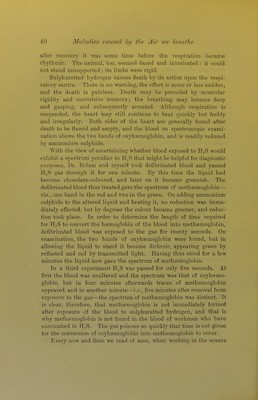
![after recovery it was some time before the respiration became rhythmic. The animal, too, seemed dazed and intoxicated : it could not stand unsupported ; its limbs were rigid. Sulphuretted hydrogen causes death by its action upon the respi- ratory centre. There is no warning, the effect is more or less sudden, and the death is painless. Death may be preceded by muscular rigidity and convulsive tremors; the breathing may become deep and gasping, and subsequently arrested. Although respiration is suspended, the heart may still continue to beat quickly but feebly and irregularly. Both sides of the heart are generally found after death to be flaccid and empty, and the blood on spectroscopic exami- nation shows the two bands of oxyhemoglobin, and is readily reduced by ammonium sulphide. With the view of ascertaining whether blood exposed to HoS would exhibit a spectrum peculiar to H^S that might be helpful for diagnostic ]inrposes, Dr. Bolam and myself took defibrinated blood and passed H.iS gas through it for one minute. By this time the liquid had become chocolate-coloured, and later on it became greenish. The defibrinated blood thus treated gave the spectrum of metheemoglobin— viz., one band in the red and two in the green. On adding ammonium sulphide to the altered liquid and heating it, no reduction was imme- diately effected, but by degrees the colour became greener, and reduc- tion took place. In order to determine the length of time required for HgS to convert the haemoglobin of the blood into meth»moglobin, defibrinated blood was exposed to the gas for twenty seconds. On examination, the two bands of oxyhsemoglobin were found, but in allowing the liquid to stand it became dichroic, appearing green by reflected and red by transmitted light. Having thus stood for a few minutes the liquid now gave the spectrum of methaemoglobin. In a third experiment was passed for only five seconds. At first the blood was unaltered and the spectrum was that of oxyhnemo- globin, but in four minutes afterwards traces of methfemoglobin appeared, and in another minute—i.e., five minutes after removal from exposure to the gas—the spectrum of methaemoglobin was distinct. It is clear, therefore, that metha3moglobin is not immediately formed after exposure of the blood to sulphuretted hydrogen, and that is why methaemoglobin is not found in the blood of workmen who have succumbed to HgS. The gas poisons so quickly that time is not given for the conversion of oxyhaemoglobin into methaemoglobin to occur. Every now and then we read of men, when working in the sewers](https://iiif.wellcomecollection.org/image/b23983759_0046.jp2/full/800%2C/0/default.jpg)