A dictionary of Islam : being a cyclopaedia of the doctrines, rites, ceremonies, and customs, together with the technical and theological terms, of the Muhammadan religion / by Thomas Patrick Hughes.
- Thomas Patrick Hughes
- Date:
- 1885
Licence: Public Domain Mark
Credit: A dictionary of Islam : being a cyclopaedia of the doctrines, rites, ceremonies, and customs, together with the technical and theological terms, of the Muhammadan religion / by Thomas Patrick Hughes. Source: Wellcome Collection.
15/770 page 3
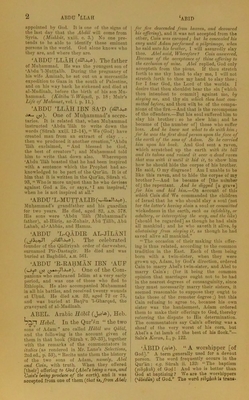
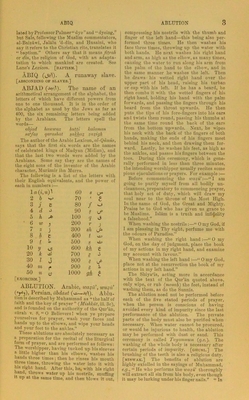
![lated by Professor Palmer “dye’’and “ dyeing, but Sale, following the Muslim commentators, al-Baizawi, Jaliilu ’d-din, and Husaini, who say it refers to the Christian rite, translates it “baptism. Others say that it meansfitrah or din, the religion of God, with an adapta- tation to which mankind are created. See Lane’s Lexicon, [baptism.] ABIQ (<3?l). A runaway slave. [absconding of slaves.] ABJAD (a=f.I). The name of an arithmetical arrangement of the alphabet, the letters of which have different powers from ono to one thousand. It is in the order of the alphabet as used by the Jews as far as 400, the six remaining letters being added by the Arabians. The letters spell the words— abjad hawwaz hutti kalaman sa'fa? qaras/iat mkhaz zazigk The author of the Arabic Lexicon, al-Qamus, says that the first six words are the names of celebrated kings of Madyan (Midian), and that the last two words were added by the Arabians. Some say they are the names of the eight sons of the inventor of the Arabic character, Mur amir ibn Murra. The following is a list of the letters with their English equivalents, and the power of each in numbers :— 1 a O'. u)\ 00 S (j- 2 b 70 t l 3 j t 80 f U: 4 d A 90 s U° 5 h 100 <1 (i 6 tv } 200 r J ( z j 300 sh J* 8 h c 400 t 9 t Is 500 s 10 y 600 kh t 20 k ,*) 700 V J 30 l J 800 y (J® 40 m (• 900 y h 50 n [exorcism.] t) 1000 gh t ABLUTION. Arabic, wa zu', wiizu' (Drij), Persian, ubdast Ablu- tion is described by Muhammad as “ the half of faith and the key of prayer ” (Mishkat, iii. 3c), and is founded on the authority of the Qur’an, surah v. 8, “ 0 Believers 1 when ye prepare yourselves for prayer, wash your faces and hands up to the elbows, and wipe your heads and your feet to the ankles.” Tlieso ablutions arc absolutely necessary as a preparation for the recital of the liturgical form of prayer, and are performed as follows: The worshipper, having tucked up his sleeves a little higher than his elbows, washes his hands threo times; then he rinses his mouth three times, throwing the water into it with his right hand. After this, he, with his right hand, throws water up his nostrils, snuffing it up at the same time, and then blows it out, compressing his nostrils with the thumb and finger of the left hand—this being also per- formed three times. He then washes his face three times, throwing up the water with both hands. Ho next washes his right hand and arm, as high as tho elbow, as many times, causing the water to run along his arm from the palm of the hand to the elbow, and in tho same manner he washes the left. Then he draws his wetted right hand over tho upper part of his head, raising his turban or cap with his left. If he has a beard, he then combs it with the wetted fingers of his right hand, holding his hand with tho palm forwards, and passing tho fingers through his beard from the throat upwards. He then jiuts the tips of his fore-fingers into his ears and twists them round, passing his thumbs at tho same time round the back of the ears from the bottom upwards. Next, he wipes his neck with the back of the fingers of both hands, making the ends of his fingers meet behind his neck, and then drawing them for- ward. Lastly, he washes his feet, as high as the ankles, and passes his fingers between the toes. During this ceremony, which is gene- rally performed in less than three minutes, the intending worshipper usually recites some pious ejaculations or prayers. For examplo:— Before commencing the wazu :—“I am going to purify myself from all bodily un- cleanness, preparatory to commencing prayer, that holy act of duty, which will draw my soul near to the throne of the Most High. In the name of God, the Great and Mighty. Praise bo to God who has given us grace to bo Muslims. Islam is a truth and infidelity a falsehood.” When washing the nostrils:—“ 0 my God, if I am pleasing in Thy sight, perfume me with the odours of Paradise.” When washing the right hand:—“ 0 my God, on the day of judgment, place tho book of mv actions in my right hand, and examine my account with favour.” When washing the left hand :—“ 0 my God, place not at the l esurrection the book of my actions in my left hand.” The Shiyaus, acting more in accordance with the text of the Qur’an quoted above, only wipe, or rub (mnsa/.i) tho feet, instead of washing them, as do the Sunnis. The ablution need not be performed before each of the five stated periods of prayer, when the person is conscious of having avoided every kind of impurity since tho last performance of the ablution. The private parts of the body must also be purified when necessary. When water cannot be procured, or would bo injurious to health, the ablution may be performed with dust or sand. This ceremony is called Toy am mum (q.v.). The washing of tho whole body is necessary after certain periods of impurity, [ghitsl.] The brushing of the teeth is also a religious duty. [miswak.] The benefits of ablution are highly extolled in the sayings of Muhammad, e.g., “ He who performs the wazu' thoroughly will oxtract all sin from his body, ovon though it may be lurking under his fingernails.” “ In](https://iiif.wellcomecollection.org/image/b24856964_0015.jp2/full/800%2C/0/default.jpg)
 No text description is available for this image
 No text description is available for this image
 No text description is available for this image