A dictionary of Islam : being a cyclopaedia of the doctrines, rites, ceremonies, and customs, together with the technical and theological terms, of the Muhammadan religion / by Thomas Patrick Hughes.
- Thomas Patrick Hughes
- Date:
- 1885
Licence: Public Domain Mark
Credit: A dictionary of Islam : being a cyclopaedia of the doctrines, rites, ceremonies, and customs, together with the technical and theological terms, of the Muhammadan religion / by Thomas Patrick Hughes. Source: Wellcome Collection.
16/770 page 4
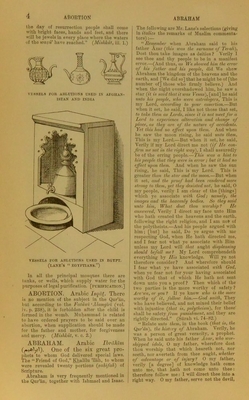
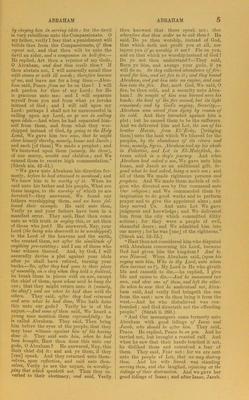
![ABRAHAM the day of resurrection people shall come with bright faces, hands and foot, and there will be jewels in every place where the waters of tho wazu’ have reached.” (Mishkdt, iii. 1.) VESSELS FOR ABLUTIONS USED IN AFGHAN- ISTAN AND INDIA VESSELS FOR ABLUTIONS USED IN EGTPT. (LANE’S “ EGYPTIANS.”) In all the principal mosques there are tanks, or wells, which supply water for the purposes of legal purification, [purification.] ABORTION. Arabic Isqdt. There is no mention of tho subject in tho Qur’an, hut according to the Fatawi ‘Alamgiri (vol. iv. p. 238), it is forbidden after tho child is formed in the womb. Muhammad is related to have ordered prayers to be said over tin abortion, when supplication should be made for the father and mother, for forgiveness and mercy. (Mishkdl, v. c. 2.) ABRAHAM. Arabic Ibrahim One of the six great pro- phets to whom God delivered special laws. The “ Friend of God,” Khalilu ’llah, to whom were revealed twenty portions ('saliifah) of Scripture. Abraham is very frequently mentioned in the Qur’&n, together with Ishmael and Isaac. The following are Mr. Lane’s selections (giving in italics the remarks of Muslim commenta- tors) :— “Remember when Abraham said to his father Azar (this was the surname, of Terah), Dost thou take images as deities? Verily 1 see thee and thy people to be in a manifest error.—(And thus, as We shoioed him the error of his father and his people, did We show Abraham the kingdom of the heavens and the earth, and [We did so] that he might be of [the number of] those who firmly believe.) And when the night overshadowed him, he saw a star (it is said that it teas Venus), [and] he said unto his people, who were astrologers, This is my Lord, according to your assertion.—But when it set, ho said, I like not those that set, to take them as Lords, since it is not meet for a Lord to experience alteration and change of place, as they are of the nature of accidents. Yet this had no effect upon them. And when ho saw the moon rising, ho said unto them. This is my Lord.—But when it set, he said, Verily if my Lord direct me not (if lie con- firm me not in the. right way), I shall assuredly be of the erring people.— This was a hint to his people that they were in error; but it had no effect upon them. And when he saw tho sun rising, ho said, This is my Lord. This is greater than the star and the moon.—But when it sot, and the proof had been rendered more strong to them, yet they desisted not, he said, 0 my people, verily I am clear of the [things] which ye associate with God; namely, the images and the heavenly bodies. So they said unto him, What dost thou ivorship ? He answered. Verily I direct my face unto Him who hath created the heavens and the earth, following the right religion, and I am not of the poh’tlieists.—And his peoplo argued with him; [but] he said, Do ye argue with me respecting God, whon He hath directed me, and I fear not what ye associate with Him unless my Lord will that aught displeasing should befall me1 My Lord comprehendeth everything by His knowledge. Will ye not therefore consider? And wherefore should I fear what ye have associated with God, when ye fear not for your having associated with God that of which He hath not sent down unto you a proof? Then which of the two parties is the more worthy of safety ? Are'we, or you? If ye know who is the more, wor thy of it, follow him.— God sait/i, They who have believed, and not mixed their belief with injustice (that, is, polytheism), for these' shall be safety from punishment, and they are rightly directed.” (Surah vi. 74-82.1 “ Relate unto them, in the book (that is, the Quran), the history of Abraham. Verily, he was a person of great veracity, a prophot. When he said unto his father Azar, who wor- shipped idols, 0 my father, wherefore dost thou worship that which heareth not, nor seeth, nor averteth from thee aught, whether of advantage, or of injuryi 0 my father, verily [a degree] of knowledge hath come unto mo, that hath not come unto thee: therefore follow me '■ I will direct thee into a right way. 0 my father, serve not the devil,](https://iiif.wellcomecollection.org/image/b24856964_0016.jp2/full/800%2C/0/default.jpg)
 No text description is available for this image
 No text description is available for this image
 No text description is available for this image