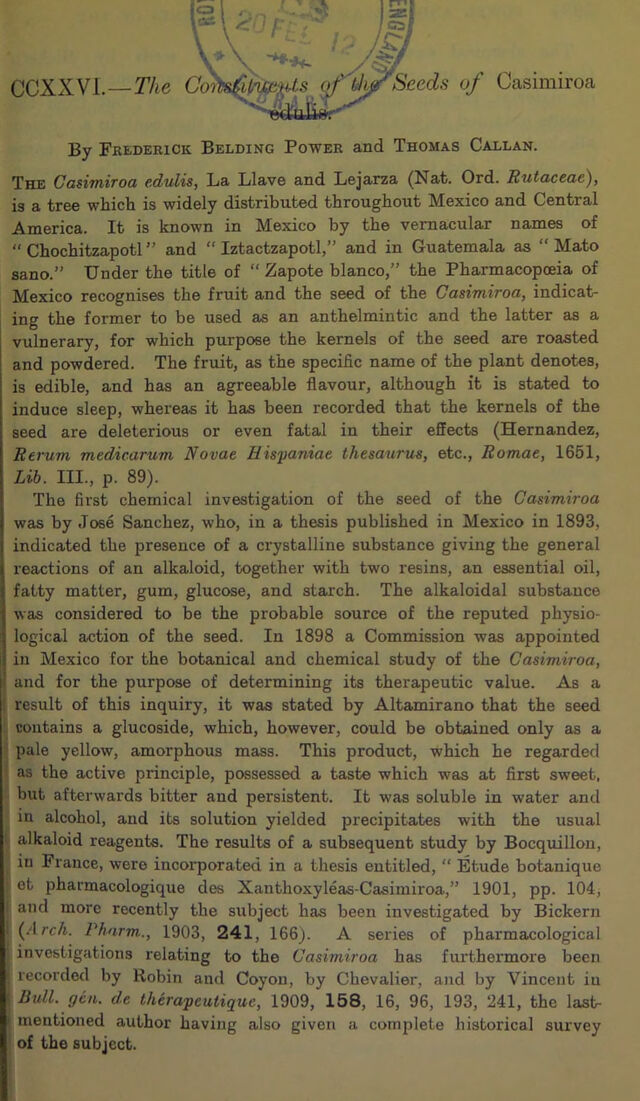
The constituents of the seeds of Casimiroa edulis / by Frederick B. Power and Thomas Callan.
- Frederick Belding Power
- Date:
- 1911
Licence: In copyright
Credit: The constituents of the seeds of Casimiroa edulis / by Frederick B. Power and Thomas Callan. Source: Wellcome Collection.
Provider: This material has been provided by The Royal College of Surgeons of England. The original may be consulted at The Royal College of Surgeons of England.
15/20 page 2005
![0’1074 gave 0-2638 C02 and 0'0698 H20. C-67 0; H — 7 2. 0-2792 neutralised 0’0359 KOH. M.W.(monobasic acid) = 436. Ca4H30O7 requires C = 67’0; H = 7'0 per cent. M.W. = 430. The above-described acid is thus shown to possess the formula G^HgoOj. Like the corresponding lactone, it is a new compound, and it is proposed to designate it casimiroic acid. A determination of the optical rotatory power of the acid gave the following result: 0'1670, made up to 20 c.c. with absolute alcohol, gave aD —1°27' in a 2-dcm. tube, whence [a]D — 868°. Casimiroic acid, unlike the lactone, is very sparingly soluble in ether, chloroform, and ethyl acetate. Its sodium salt is very readily soluble in water and in alcohol. On the addition of a solution of copper sulphate to a neutral solution of the sodium salt, a pale blue, amorphous precipitate of copper casimiroate was produced, the analysis of which, however, indicated it to consist of a basic salt. Silver Casimiroate, C23TT20O5-CO2Ag.—This salt was obtained as a white, amorphous precipitate on the addition of a solution of silver nitrate to a solution of the sodium salt. It is sparingly soluble in water, and gradually darkens on exposure to light: 0'1435 of salt gave, on ignition, 00296 Ag. Ag = 206. C24H2907Ag requires Ag = 20l per cent. Methyl Casimiroate, C23H290r/C02*CH3.—This ester was prepared by passing dry hydrogen chloride into a solution of the acid in methyl alcohol at the boiling temperature. It was very soluble in alcohol, and could only be obtained with difficulty in a crystalline state from dilute alcohol, when it melted at 108—110°: 0-1086 gave 0‘2666 C02 and 0‘0739 H20. C = 66‘9; H = 7'6. C25H3207 requires C=67'5 ; H = 7'2 per cent. Acctylcasimiroic Acid, C23H2801(0,C0,CH3),C02H.—This was obtained by heating casimiroic acid with acetic anhydride, pouring the product into water, and digesting the resulting precipitate with dilute aqueous sodium carbonate, when, on acidifying the alkaline liquid, the acetyl derivative was precipitated. It was exceedingly soluble in the usual organic solvents, but could be obtained from dilute alcohol in colourless, microscopic needles. The acetyl deriv- ative has no sharp melting point, but gradually decomposes at temperatures above 142°: 0-1149 gave 0-2774 C02 and 0 0738 H20. 0 = 65 8; H = 7'l. C^jHjoOg requires C = 65-8; H = 6 8 per cent.](https://iiif.wellcomecollection.org/image/b22433028_0017.jp2/full/800%2C/0/default.jpg)




 No text description is available for this image
 No text description is available for this image
 No text description is available for this image