Volume 4
An arrangement of British plants; according to the latest improvements of the Linnaean system. To which is prefixed, An easy introduction to the study of botany. Illustrated by copper plates / by William Withering, M.D. F.R.S. member of the Royal Academy of Sciences at Lisbon; Fellow of the Linnæan Society; honorary member of the Royal Medical Society at Edinburgh, &c.
- William Withering
- Date:
- 1796
Licence: Public Domain Mark
Credit: An arrangement of British plants; according to the latest improvements of the Linnaean system. To which is prefixed, An easy introduction to the study of botany. Illustrated by copper plates / by William Withering, M.D. F.R.S. member of the Royal Academy of Sciences at Lisbon; Fellow of the Linnæan Society; honorary member of the Royal Medical Society at Edinburgh, &c. Source: Wellcome Collection.
Provider: This material has been provided by Royal College of Physicians, London. The original may be consulted at Royal College of Physicians, London.
22/452 (page 10)
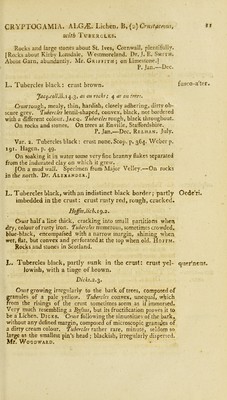
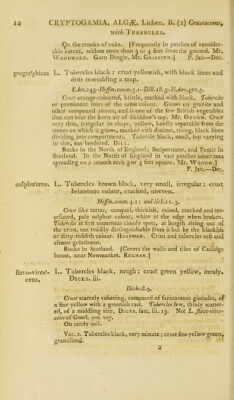
![with Tubercles. from -§ to 3 inches over, ash-coloured, wrinkled, lefs wrinkled in the centre, rather leafy at the edge. Dill. L. incanus. Relh. n. 846. L. canescens, and L. canus of Gmelin Syst. veg. Under one name described as producing tubercles, under the other as bearing saucers. Mr. Dickson speaks of saucers, Mr. Relhan of tubercles. My specimens are tubercied. it may prove one of those Lichens which occasionally bears the one or the other. Walls and trunks of trees. [Very common on old trees, but rarely in fructification. Mr. Woodward. About Garn, but chiefiy on hawthorn. Mr. Griffith.] L. Tubercles blackish; crust bluish. Dicks.h.s.—HojfmJich.32.3-F/.dan. 1064.1. (not Dill.82.2, as in Lightf.) Crust fixed to the earth, or to decayed mofses, composed of whitish ash-coloured granulations. Tubercles very irregular in shape, ash-coloured when young and small, blackish when old. Patellaria vesicularis. Hoffim. L. Candidas. Weber, and FI. dan. On the Highland rocks, but not common. Lightf. 805. [Nor- folk and Suffolk. Mr. Woodw.] P. Jan.—Dec. ni'ger. L. Tubercles black; roundish: crust black. Hojfm.enum. 3.6, but the tubercles represented as if white. Crust granulated, hard, dry, very widely spreading. Tubercles • convex, of the size of mustard seed. Huds. Imits young state the crust is thin and smooth. When more advanced the crust cracks, and the fructifications begin to appear, but at first not raised above the crust, and not easily to be distinguished from it. When older still the crust is very much cracked, the portions raised up, convex, granulated; the tubercles very numerous, raised above the crust, convex, smooth. The specimens which gave rise to these remarks were communicated by Mr. Griffiths, also another specimen which had grown in the shade, wherein the crust is thin and even, not black but blackish brown ; the tuber- cles black with a smooth polished surface. Mr. Griffith has discovered a further change in this Lichen, as curious as it must be unexpected, and which is sufficient to shew that many discoveries yet await our enquiries in this singu- lar tribe of plants. I shall transcribe his own words,—“ In the more advanced state of L. niger, small glaucous leaves ifsue from the dark ground, which in time form the imbricated L. plumbeus. The dark ground (which is now of a spongy texture,) becomes elevated, and forms that cork-like substance which is attached to the L. plumbeus.” cceruleo-ni'- gricans.](https://iiif.wellcomecollection.org/image/b28039841_0004_0022.jp2/full/800%2C/0/default.jpg)