Licence: Public Domain Mark
Credit: Physical diagnosis / by Richard C. Cabot. Source: Wellcome Collection.
Provider: This material has been provided by the Francis A. Countway Library of Medicine, through the Medical Heritage Library. The original may be consulted at the Francis A. Countway Library of Medicine, Harvard Medical School.
27/558 (page 3)
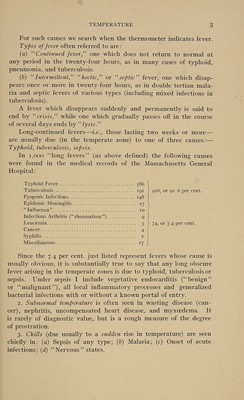
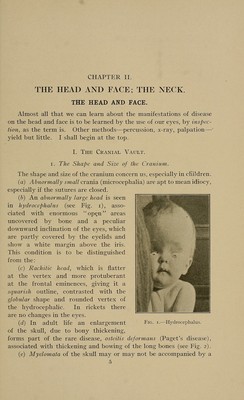
![For such causes we search when the thermometer indicates fever. Types of fever often referred to are: (a) Continued fever, one which does not return to normal at any period in the twenty-four hours, as in many cases of typhoid, pneumonia, and tuberculosis. (6) ''Intermittent, hectic, or septic fever, one which disap- pears once or more in twenty-four hours, as in double tertian mala- ria and septic fevers of various types (including mixed infections in tuberculosis). A fever which disappears suddenly and permanently is said to end by crisis, while one which gradually passes off in the course of several days ends by lysis. Long-continued fevers—i.e., those lasting two weeks or more— are usually due (in the temperate zone) to one of three causes:— Typhoid, tuberculosis, sepsis. In 1,000 long fevers (as above denned) the following causes were found in the medical records of the Massachusetts General Hospital: Typhoid Fever 586 ] Tuberculosis 192 j- 926, or 92 .6 per cent. Pyogenic Infections 148 J Epidemic Meningitis 27 Influenza 10 Infectious Arthritis (rheumatism) 9 Leucaemia 5 Cancer 4 Syphilis 2 Miscellaneous 17 Since the 7.4 per cent, just listed represent fevers whose cause is usually obvious, it is substantially true to say that any long obscure fever arising in the temperate zones is due to typhoid, tuberculosis or sepsis. Under sepsis I include vegetative endocarditis (benign or malignant), all local inflammatory processes and generalized bacterial infections with or without a known portal of entry. 2. Subnormal temperature is often seen in wasting disease (can- cer), nephritis, uncompensated heart disease, and myxoedema. It is rarely of diagnostic value, but is a rough measure of the degree of prostration. 3. Chills (due usually to a sudden rise in temperature) are seen chiefly in: (a) Sepsis of any type; (b) Malaria; (c) Onset of acute infections; (d) Nervous states. 74, or 7.4 per cent.](https://iiif.wellcomecollection.org/image/b21175883_0027.jp2/full/800%2C/0/default.jpg)