Notes on bronze sickles : with special reference to those found in Scotland / by John Alexander Smith.
- Date:
- [1868?]
Licence: Public Domain Mark
Credit: Notes on bronze sickles : with special reference to those found in Scotland / by John Alexander Smith. Source: Wellcome Collection.
Provider: This material has been provided by the Royal College of Physicians of Edinburgh. The original may be consulted at the Royal College of Physicians of Edinburgh.
5/10 page 379
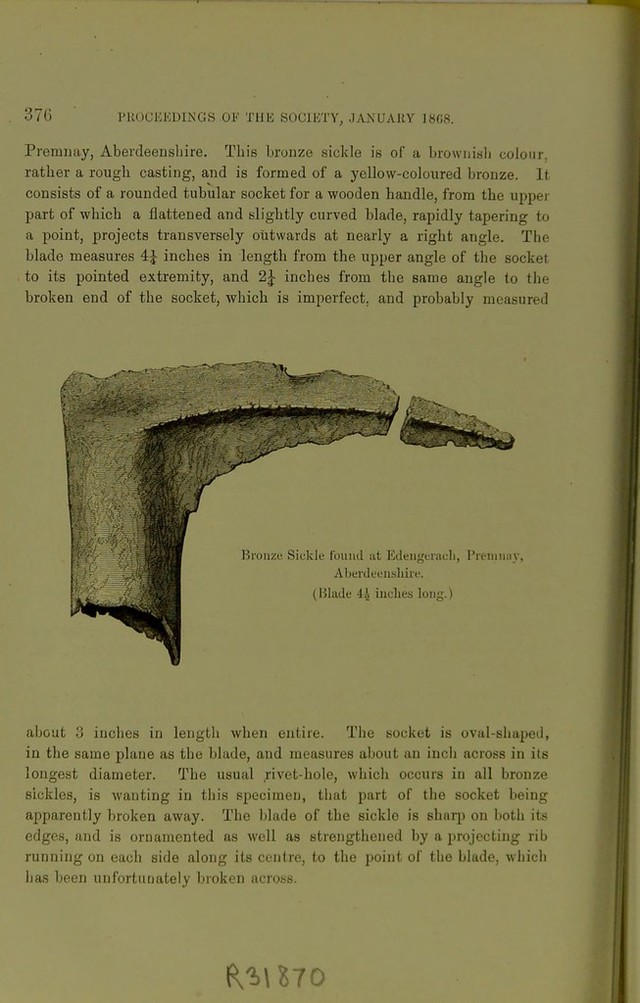
![There is another example of a bronze sickle in the Museum of the Society; which, however, was found in Ireland; It corresponds in a gene- ral way with the one found in the Tay, but is less in size, the metal being of a brown colour. The tubular socket is tapering, slightly flattened or oval in shape, and is pierced with a rivet-hole; it measures 2 inches in length. The blade is 1 inch in breadth, and is broken across the point, It has probably been about 4 inches long; a smooth rounded belt or pro- jection runs from the top of the socket along the middle of the blade; on each side of this belt there are two ornamental parallel projecting lines, and beyond these are the edges of the blade, which are sharp. At the top of the socket a short ornamental curve, with projecting border, rises up to join the upper edge of the blade. This sickle formed part of the collection of Irish antiquities made by the late Mr John Bell, Dungannon. Mr Franks, of the British Museum, when describing bronze sickles in the Horaj Ferales, says,— They are rare objects in all countries, but are less rarely found in Ireland than elsewhere. There are eleven speci- mens in the Koyal Irish Academy, and four in the British Museum, but all are Irish. In the important Catalogue of the Eoyal Irish Academy, these sickles are shown to form three apparent groups or varieties— First, those with the tubular socket pierced through and through, forming a haft hole for the handle, and with a short and slightly curved or angular blade springing laterally from the socket. Next, those more allied to the specimens I have been describing, with sockets closed above, and lateral blades, some of them, however, more ornamented in character; this shape is stated to be the type of the majority of the sickles found in Ireland. And, lastly, there are others with a more curved and narrow blade, springing upwards from the top of the socket or handle, and thus more resembling in shape the much larger iron sickles used by the reapers in our own day. Few specimens of bronze sickles have been found in England. [I exhibit diagrams of these examples.] One, a simple bent blade, sharp on one of its edges, found in Wicken, Cambridgeshire, is referred to by Mr Franks, and is figured in the •' Archaeological Journal, vol. vii. p](https://iiif.wellcomecollection.org/image/b21943758_0007.jp2/full/800%2C/0/default.jpg)