A manual of instruction in the principles of prompt aid to the injured : including a chapter on hygiene and the drill regulations for the hospital corps, U.S.A. : designed for military and civil use / by Alvah H. Doty.
- Alvah Hunt Doty
- Date:
- 1898, ©1894
Licence: Public Domain Mark
Credit: A manual of instruction in the principles of prompt aid to the injured : including a chapter on hygiene and the drill regulations for the hospital corps, U.S.A. : designed for military and civil use / by Alvah H. Doty. Source: Wellcome Collection.
Provider: This material has been provided by the Francis A. Countway Library of Medicine, through the Medical Heritage Library. The original may be consulted at the Francis A. Countway Library of Medicine, Harvard Medical School.
59/336 (page 35)
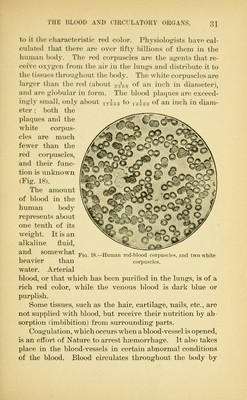
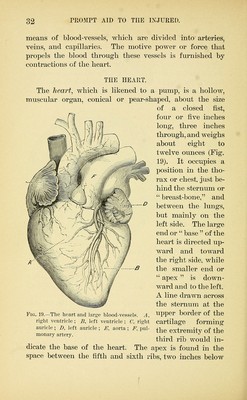
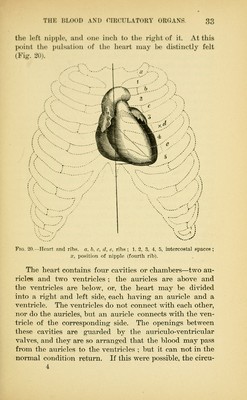
![blnod IS f(»i-(((l into llic i-iulit ventricle through tlie ri^ht luriculo-ventricular opcnin*^. Tlie contraction of tlie ven- tricle which follows, closes the valves g-uarclinjjc this o])eii- inpf; the hlood, l)ein<^'' then unable to return to the auricle, is forced out of the ventricle into the pulmonary artery, a large blood-vessel connected with the right ventricle; valves also guard the oi)ening into this vessel. The pul- monary artery divides into two branches, carrying the blood to each lung ; after reaching these organs, the branches of the artery grow smaller and exceedingly numerous, and at last they become minute vessels known as capillaries, which surround the air-vesicles of the lungs. The venous blood has now been carried from the heart to the lungs, and it is at this point that the blood in the capillaries surrounding the air-vesicles frees itself of car- bonic-acid gas and some other impurities, and receives in return oxj'gen from the air contained in the vesicles. The blood is now changed in character: the color, instead of being blue or venous, is now^ red or arterial, and thus enriched and purified, and in the condition to nourish the tissues, is carried from the lungs to the left auricle of the heart by four large blood-vessels, the pulmonary veins. These vessels are continuous with the pulmonary artery through the medium of the capillaries which surround the air-vesicles, and have been already referred to. The left auricle, after receiving the blood from the pulmonary veins, contracts and its contents pass into the left ven- tricle, which, being filled, immediately contracts and forces the blood into the aorta and closes the left auriculo- ventricular valve, thus preventing the return of the blood to the auricle. The opening from the ventricle into the aorta is also guarded by valves w^hich bar the return of the blood to the ventricles. The aorta begins at the left ventricle, is the main artery of the body, and through it passes the arterial blood into the smaller arteries and capillaries throughout the system. In these latter vessels the nutrition contained in the blood is given direct to the](https://iiif.wellcomecollection.org/image/b21049543_0059.jp2/full/800%2C/0/default.jpg)