On epidemic cholera and diarrhoea : their prevention and treatment by sulphur / by John Grove.
- Grove, John, 1815-1895
- Date:
- 1865
Licence: Public Domain Mark
Credit: On epidemic cholera and diarrhoea : their prevention and treatment by sulphur / by John Grove. Source: Wellcome Collection.
Provider: This material has been provided by The Royal College of Surgeons of England. The original may be consulted at The Royal College of Surgeons of England.
24/44 page 24
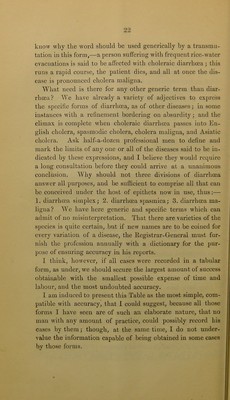
![tlie morning dose of brimstone and treacle. Mr. Dickens, how- ever, has immortalized the compound in ^ Nicholas Nickleb}\^ It is seldom that anything obtains popularity unless there be a substantial reason; whether the public undei’stand the matter or not is of little consequence, they obtain an advantage in some way or other, and that is sufficient for them. We have instances in medicine parallel to this : burnt sponge was used as a valuable remedy in scrofulous diseases, but why it was useful could not be understood until the discovery of iodine, when it was found that the properties of the burnt sponge were due to that elementary principle. Sulphur is an im- portant constituent of the human body. It is found in the brain, in the nervous system, in its pure state dissolved, or in combination with fatty or oily matter, for oil is a solvent of sulphur. It is also found as a constituent of protein, and in the blood in combination with albumen and fibrin. Salts of sulphuric acid also exist in notable quantity in most of the secretions and excretions of the human body ; in fact, in some form or other, there is no part of the body which does not contain it either in its simple or compound state. This, to my mind, is a strong point in favour of the exhibition of sulphur as a medicine, and I would argue thus:—We are aware that disease depends occasionally upon a deficiency of iron in the blood; we restore to the system that which it has lost, and hcaltli returns. We are yet in the dark as to the cause of this tendency to a loss of the ferruginous salt from the blood in young women. We only know it to be a common occurrence; it may arise from their sedentary habits, which allows an in- sufficient exposure to light, and thus engendering imperfect assimilation; it may be from various other causes; but knowing the fact, may we not also assume that sulphur occasionally may be deficient, though at present v/e are not able to detect the symptoms which indicate such a state? It is, moreover, quite certain that in some states of the body other constituents of the organism have a tendency to pass away. Tlic experiments instituted ])y Dr. Bence Jones on the amount of phospliates in tlie urine duriiiK the existence of diseases connected with](https://iiif.wellcomecollection.org/image/b2234651x_0024.jp2/full/800%2C/0/default.jpg)



 No text description is available for this image
 No text description is available for this image
 No text description is available for this image