Note upon the presence of amido acids in the blood and lymph as determined by the Beta naphthalinsulphochloride reaction / by W.H. Howell.
- William Henry Howell
- Date:
- [1906?]
Licence: Public Domain Mark
Credit: Note upon the presence of amido acids in the blood and lymph as determined by the Beta naphthalinsulphochloride reaction / by W.H. Howell. Source: Wellcome Collection.
3/12 page 273
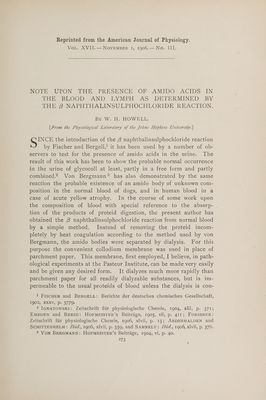
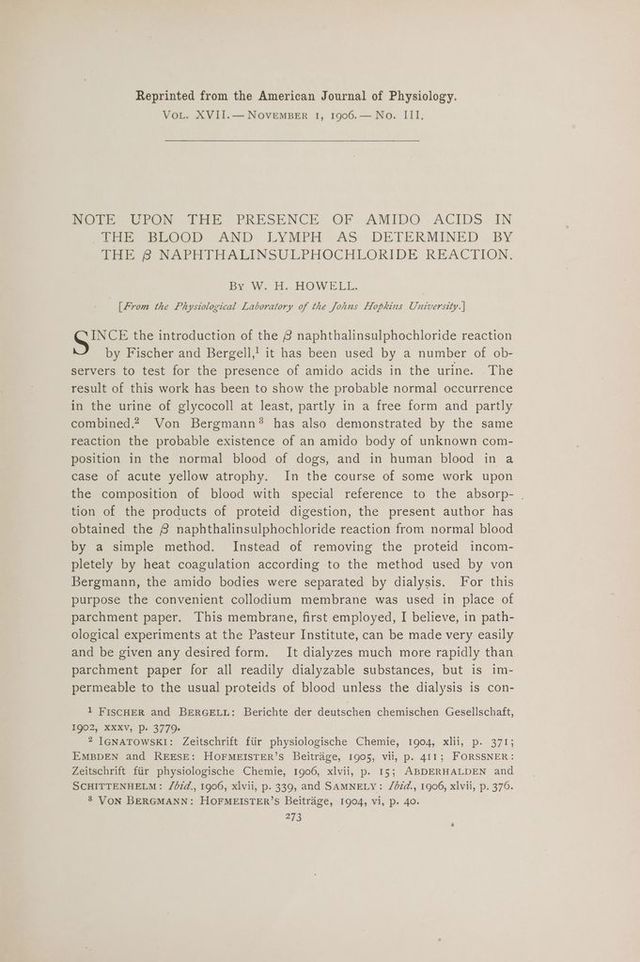
![Reprinted from the American Journal of Physiology. VoL. XVII.— NOVEMBER 1, 1906.— No. III, OTE UPON LHE PRESENCE OF AMIDO ACIDS IN THE BLOOD AND LYMPH AS DETERMINED BY THE 8 NAPHTHALINSULPHOCHLORIDE REACTION. BY WW. He HOWELL, [From the Physiological Laboratory of the Johns Hopkins University.] INCE the introduction of the 8 naphthalinsulphochloride reaction by Fischer and Bergell,! it has been used by a number of ob- servers to test for the presence of amido acids in the urine. The result of this work has been to show the probable normal occurrence in the urine of glycocoll at least, partly in a free form and partly combined.2~ Von Bergmann? has also demonstrated by the same reaction the probable existence of an amido body of unknown com- position in the normal blood of dogs, and in human blood in a case of acute yellow atrophy. In the course of some work upon the composition of blood with special reference to the absorp- | tion of the products of proteid digestion, the present author has obtained the 8 naphthalinsulphochloride reaction from normal blood by a simple method. Instead of removing the proteid incom- pletely by heat coagulation according to the method used by von Bergmann, the amido bodies were separated by dialysis. For this purpose the convenient collodium membrane was used in place of parchment paper. This membrane, first employed, I believe, in path- ological experiments at the Pasteur Institute, can be made very easily and be given any desired form. It dialyzes much more rapidly than parchment paper for all readily dialyzable substances, but is im- permeable to the usual proteids of blood unless the dialysis is con- 1 FISCHER and BERGELL: Berichte der deutschen chemischen Gesellschaft, 1902, XXXV, P. 3779.- 2 IGNATOWSKI: Zeitschrift fiir physiologische Chemie, 1904, xlii, p. 371; EMBDEN and REESE: HOFMEISTER’S Beitrage, 1905, vii, p. 411; FORSSNER: Zeitschrift fiir physiologische Chemie, 1906, xlvii, p. 15; ABDERHALDEN and SCHITTENHELM: /dzd., 1906, xlvii, p. 339, and SAMNELY: Jdzd., 1906, xlvii, p. 376. 8 VON BERGMANN: HOFMEISTER’S Beitrage, 1904, vi, p. 40.](https://iiif.wellcomecollection.org/image/b33441042_0003.jp2/full/800%2C/0/default.jpg)