Lectures on the development of the gravid uterus / by William O. Priestley.
- Priestley, William Overend, 1829-1900.
- Date:
- 1860
Licence: Public Domain Mark
Credit: Lectures on the development of the gravid uterus / by William O. Priestley. Source: Wellcome Collection.
Provider: This material has been provided by The Royal College of Surgeons of England. The original may be consulted at The Royal College of Surgeons of England.
20/114 page 16
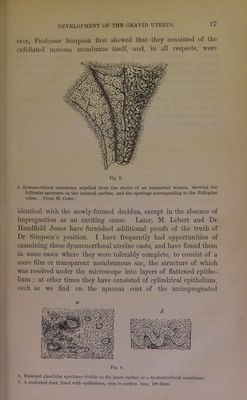
![tormin^r, according to Professor Uoodsir and M. Coste, polygonal meshes in the inter-follicular substance. In the deeper layers elongated meshes are found, formed chiefly by straight vessels brandling dichotomously and anastomosing freely. These may be seen ramifying on the dorsal surface of the membrane, and pene- trating its structure, in most very young ova recently expelled. If development be further advanced, the blood-vessels are larger, and where they have been torn across in the sepai'ation from the uterus, they ajipear as open-mouthed canals entering the outer surface of the decidua obliquely, among tlie glandular tubules before described, and distinguished by their thinner coats, and the absence of a glandular lining. A point of no little interest to the practitioner in connection with the structure and formation of the decidua i.s, that a mem- brane, in most respects identical with that membrane, so far as I have yet described it, may be formed and thrown off from the uterus as the product of diseased action, and without any sexual inter- course having ever occurred. Were you ignorant of the fact that substances may be expelled from the uterus, independent of impregnation, which bear a close resemblance to the products of concej)tion, you may be led into the serious error of impugning the character of an innocent person, and, perhap.s, bring cliscredit on yourselves. False decidure, which are called the membranes of dysmenorrhoea, are separated from the uteri of certain patients who suffer from painful menstruation, both before and after marriage. The suffering which accompanies the expulsion of these substances, in a patient I lately attended, was sometimes so intense as to be compared to the pains of laboiu-; and in many cases the pain is not confined to the actual menstrual period, but encroaches more or less on the intervals, and seriou.sly affects the general health of the subject of it. The membranes thus discharged with the menses are most frequently in shreds or fragments, with a rough villous external, and a smooth internal surhxce. Occasionally, however, they are expelled quite entire, and in shape bear the impress of the triangular form of the uterine cavity, the openings corresponding to the Fallopian tubes, and cervical canal being discernible. Some- times I have seen the cavity of the membrane filled with coagulated ])lood, layers of fibrin so obscuring its real structure that it was demonstrated with difficulty. They were long .supposed to consist of the products of inflammation, and to be formed of coagulable lymph exuded from the uterine internal surface. In 184G, how-](https://iiif.wellcomecollection.org/image/b22334452_0022.jp2/full/800%2C/0/default.jpg)