Lectures on the development of the gravid uterus / by William O. Priestley.
- Priestley, William Overend, 1829-1900.
- Date:
- 1860
Licence: Public Domain Mark
Credit: Lectures on the development of the gravid uterus / by William O. Priestley. Source: Wellcome Collection.
Provider: This material has been provided by The Royal College of Surgeons of England. The original may be consulted at The Royal College of Surgeons of England.
38/114 page 34
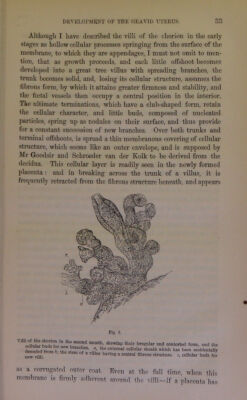
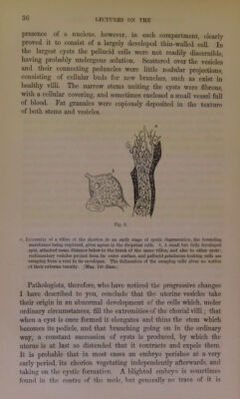
![beeu macerated for a day or two iu water—it may be separated as a cellular sheatb, both from the trunks and extremities of the tufts. It forms, as we shall see aftei'wards, a part of the maternal portion •of the placenta. The chorion is subject to certain morbid alterations, with which it is of importance you should make yourselves acquainted. Some of these may be left mrtil we come to the morbid anatomy of the placenta; but there is one .singidar transformation, which seems peculiar to the early mouths, and which needs some descrij)tiou here. The pathological change 1 allude to is one in which the villi undergo a transformation into vesicles or cysts, varying from the size of a miUet seed to that of a grape, and these are intimately united together at various ])oints by thin stems or ^Xidicles. When the chorion has undergone this alteration by disease, repeated discharges of blood and water take place at intervals fiom the vagina, and at length the patient experiences all the symptoms of miscarriage, and expels a mass from the uterus either eiitu'C or in separate portions. The substance expelled has in some cases the appearance of a fleshy cast of the interior of the womb, cysts being imbedded in its substance ; in others, it bears some resemblance^ to a bunch of grapes, an immense number of little bladders being strung together in clusters, and united in a plexiform arrangement. These two fomrs are known to obstetricians under the appellation of the vesicular or hydatid mole, the one being simply a luoie exaggerated form than the other of the same morbid concUtiom The most ridicidous mistakes have been made as to the nature of these vesicular bodies thus expelled from the uterus, and it is probable that some of the aUeged instances, where an incredible number of supposed ova have been extruded at one time, were cases of this description. In Fare’s Siu-geiy it is recounted ‘ that the Countess Margaret, daughter to Florent IV., Earl of HoUaud, and spouse to Coiuit Herman of Heneberg, on Good-Eriday, in the year of our Lord 127G, and of her age 42, brought forth at one birth 3G5 inflints; whereof 182 are said to have beeu males, as many females, and the odd one an hermaphrodite, who were aU baptised, those by the name of John, these by that of Elizabeth, in two brazen dishes, by Don Wmiani, Suffragan Bishop of Treves. It is added, ‘ the basins are still to be seen in the vfllage of Losdun, where all strangers go (on purpose) from the Hague, being reckoned among the gi-eat curiosities of Holland. Pos^bly these 3G5 infants, HO authenticated, were nothing more](https://iiif.wellcomecollection.org/image/b22334452_0040.jp2/full/800%2C/0/default.jpg)