Volume 1
A compendium of anatomy, human and comparative : intended principally for the use of students.
- Andrew Fyfe
- Date:
- 1826
Licence: Public Domain Mark
Credit: A compendium of anatomy, human and comparative : intended principally for the use of students. Source: Wellcome Collection.
Provider: This material has been provided by The University of Leeds Library. The original may be consulted at The University of Leeds Library.
183/498 page 163
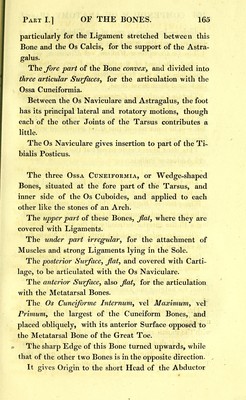
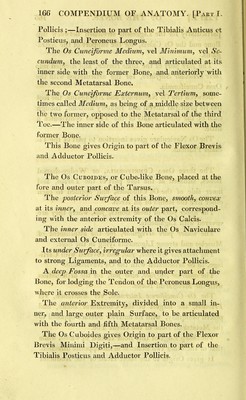
![/ Faet I.] OF THE BONES. 163 tory motion, except in the extended state, when there is a little of each. In a Foetus, a considerable portion of this Bone is ossified. The Os Calcis, vel Calcaneus, or Heel-bone, the largest of the Tarsal Bones, situated under the Astra- galus, and in the back part of the Foot. A large rough Tuberosity^ or Knob, projecting be- hind to form the Heel, and to make one end of the Arch of the Foot. A Superjicial Cavity in the upper and back part of this Knob, for the insertion of the Tendo Achillis. A smooth Convexity on the upper part of the Bone, for its articulation with the under and back part of the Astragalus. A Fossa or Sinuous Cavity at the fore part of this articulating Surface, running forwards and outwards, and giving origin to strong Ligaments which are in- serted into the corresponding Fossa of the Astragalus. Two Prominences at the inner and fore part of ,the Bone, concave, and smooth above, with a Pit between them, for the articulation with the under and fore part of the Astragalus. ;« From the Posterior Prominence, the Cartilaginous Ligament arises, which is fixed to the Os Naviculars. A large Cavity or Arch at the inner side of the Bone, between the posterior of the two last mentioned Pro- cesses and Projection of the Heel, for lodging the Ten- dons of the long Flexors of the Toes, together with the Vessels and Nerves of the Sole. A Depression in the external Surface of the Bone,](https://iiif.wellcomecollection.org/image/b21506887_0001_0185.jp2/full/800%2C/0/default.jpg)