A handy-book of forensic medicine and toxicology / by W. Bathurst Woodman and Charles Meymott Tidy.
- Date:
- 1877
Licence: Public Domain Mark
Credit: A handy-book of forensic medicine and toxicology / by W. Bathurst Woodman and Charles Meymott Tidy. Source: Wellcome Collection.
Provider: This material has been provided by the Royal College of Physicians of Edinburgh. The original may be consulted at the Royal College of Physicians of Edinburgh.
1112/1268 (page 1076)
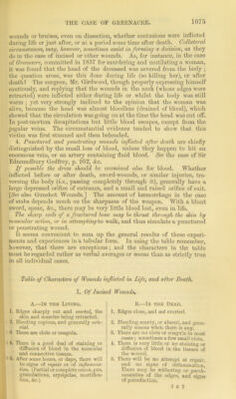
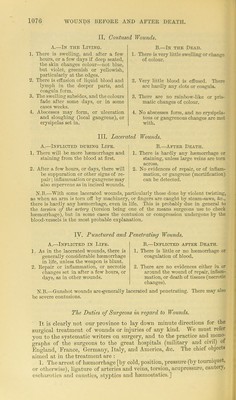
![acute diseases, provided the corpse be fairly young, and the disease be not accompanied with putrescence, we shali get many of the pheno- mena of life, if wounds be inflicted. As in the case of bums, the authors have themselves made experiments on this subject, with results similar to those about to be detailed. To begin with— 1. Incised wounds, inflicted soon after death, do not materially differ from those made in life, though, as a general rule, there is less haemorrhage. The skin and muscles gape open (as may be seen in butcher’s meat, particularly veal, in which butchers often cut patterns in the tissues (stars, &c.). Orfila appears to have been the first, or one of the first, to make experiments of this kind. [“Lecons,” 2nd ed., vol. iL, p. 540.] His conclusions were that wounds-inflicted by a cutting instru- ment immediately after death, could not be certainly distinguished from those inflicted during life. Dr. Taylor and Mr. Aston Key made experi- ments on amputated limbs, which the Authors and others have repeated with similar results. The original experiments will be found in his work, vol. i., p. 460, &c. One or two will suffice to illustrate our meaning. Two minutes after a leg was amputated a deep incised wound was made in the calf; there was considerable retraction of skin, and the adipose tissue protruded ; there was not much bleeding. After twenty-four hours a fresh examination showed the edges red, bloody, and everted. There had, however, been little bleeding. There were no coagula adhering to the muscles, and only one or two soft clots at the bottom of the wound. When an incision was made ten minutes after amputation it was scarcely possible to confound the wound with one made in life, for there was little gaping, the edges were pale, and there was scarcely any haemorrhage. But after twenty-four hours there were some clots at the bottom of the wound. When two or three hours had elapsed from the amputation there were never any clots, though a little liquid blood was effused. The authors found that in one or two cases retraction of the skin took place as long as ten or twelve hours after the amputation. Those who are familiar with post-mortem examinations will not confound the rebound of skin, muscles, &c., which have been rendered tense by accumulations of dropsical fluid or gases, with the gaping of elastic tissues, of which we speak. We are therefore warranted, both by experience and experiments, to state that, unless incised wounds have been inflicted a very short time after death, there will be little difficulty in dis- tinguishing them from those inflicted in life, because wounds inflicted after death (1) Do not bleed like those in living persons,* and hence (2) are free from clots, and (3) generally paler; whilst (4) the edges do not gape, and are not everted, but are in close approximation to each other. 2. As to lacerated wounds, it is confessedly very difficult to judge whether they have been inflicted before or after death, except when their character more nearly resembles incised than contused wounds. 3. Of contused wounds we have already given the characters in life. * Owing to decomposition, and the formation of lakes out of the blood-colouring, and sometimes, perhaps, to a watery condition of blood during life, wounds some- times bleed afresh after death. It was formerly supposed that the corpse ot a murdered man would thus bleed when touched by the murderer. See tbe remark- able case of Jane Norkott, and the trial of Standsfield for the minder of Ins father. Hargrave’s “State Trials,” vol. x., Appendix, No. 2, p. 29; and^ol. iv. P- ' and the Notes to Beck, toe. cit., pp. 544 and 545. Ihesc cases will be noticei ag at the end of this chapter.](https://iiif.wellcomecollection.org/image/b21907869_1112.jp2/full/800%2C/0/default.jpg)