A handy-book of forensic medicine and toxicology / by W. Bathurst Woodman and Charles Meymott Tidy.
- Date:
- 1877
Licence: Public Domain Mark
Credit: A handy-book of forensic medicine and toxicology / by W. Bathurst Woodman and Charles Meymott Tidy. Source: Wellcome Collection.
Provider: This material has been provided by the Royal College of Physicians of Edinburgh. The original may be consulted at the Royal College of Physicians of Edinburgh.
1136/1268 (page 1100)
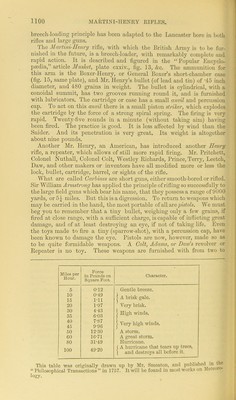
![This tube may be only from three or four to six inches long, as in many pistols, or it may vary from two feet to six, or in some very old weapons, to seven or eight feet, as in carbines, rifles, guns, Ac. The interior of the tube may be a “smooth bore,” or it may be grooved, as in the case of rifles j and in these weapons, in modern times, the grooves do not run straight, but are curved iu a spiral form, making from \ or of a turn to several complete turns in the course of the length of the tube. This spiral or twisted ai'rangement of the grooves is called rifling * It gives the name to the Enfield, Minie, Whitworth, and other rifles, and gives great precision of flight to the bullets. The bore or shape of the tube may be more or less circular, as in old guns; elliptical, as in the Lan- ccister rifles and cannon ; hexagonal, as in the Whitworth rifle; or irregular, as in many old and badly made weapons. As regards the method of loading—in former times all weapons, whether sporting or military, large or small, were loaded at the muzzle, or further end of the tube (point of exit); now-a-days, a very large number of fire-arms are what is called breech-loaders, that is, the charge which now generally consists of a cart- ridge of some kind, containing both powder and ball, is put in at the near end of the tube; in other words, in a long gun, near to the shoulder, and, of course, close to the lock and trigger. The above remarks, as to smooth and rifled-bores, and as to muzzle and breech-loaders, apply to both large and small sizes of fire-arms,—to pistols as well as to cannon of enormous size. As regards the mode of firing, the most ancient weapons were matchlocks. A light was first obtained, either from flint and steel, or from a torch, or in forts and ships from a fire kept burning. A sulphur match lighted from this was used to discharge the weapon. Although flint-locks were used in France as long ago as 1630, it does not appear that the English adopted them until 1677, or thereabouts. A few weapons of this description, chiefly long duck-guns, or ancient carbines, are still to be met with in country places. Such guns are sometimes given to boys employed in bird keeping. Accidents will sometimes happen from too much powder being used for the priming of such weapons. At the beginning of this present century, the weight of the English musket and bayonet was 11 pounds 4 ounces. 'The bullets used were 16 to the pound. The charge of powder [F.G.] 6 drams avoirdu- pois (J ounce), and the diameter of the bore was '753 inch. The bullets were, of course, spherical, and the locks were flint-locks. In 1807, the Rev. Mr. Forsyth took out a patent for a priming with a fulminating composition, which has been superseded by the percussion caps now used, in which fulminate of mercury, or some other fulminate is used, as well as chlorate of potash, ground glass, Ac. The superiority even of the first percussion muskets was strikingly shown in the trials instituted in 1834. Six thousand rounds were fired from six specimens of each de- scription of arm, and the experiments conducted iu all weathers. Out of 6,000 rounds from the flint locks, there were 922 mis-fires, being 1 hi 6 J,, whereas from the percussion musket there were ouly 36 misses in 6,000 rounds, or 1 in 166. Besides that, the precision of fire was greater. The success of modern percussion caps is still more striking. The percussion caps permitted also of less powder being used, the 6 drams being at once reduced to 4A * The spares between the grooves are called lands—these, in Major Nuthall s rifle, have rounded smooth edges.](https://iiif.wellcomecollection.org/image/b21907869_1136.jp2/full/800%2C/0/default.jpg)