A handy-book of forensic medicine and toxicology / by W. Bathurst Woodman and Charles Meymott Tidy.
- Date:
- 1877
Licence: Public Domain Mark
Credit: A handy-book of forensic medicine and toxicology / by W. Bathurst Woodman and Charles Meymott Tidy. Source: Wellcome Collection.
Provider: This material has been provided by the Royal College of Physicians of Edinburgh. The original may be consulted at the Royal College of Physicians of Edinburgh.
1143/1268 (page 1107)
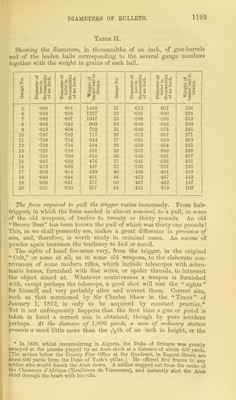
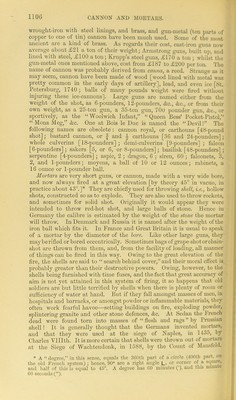
![Table II. Showing the diameters, in thousandths of an inch, of gun-barrels and of the leaden balls corresponding to the several gauge numbers together with the weight iu grains of each ball. Gauge No. Diameter of lore in thousandths of an Inch. Diameter of bullet in thousandths of an Inch. Weight of leaden ball in Grains. Gauge No. Diameter of bore in thousandths of an Inch. Diameter of bullet in thousandths of an Inch. Weight of l leaden ball in j Grains. 5 •996 •991 1460 21 •612 •607 336 6 •943 •938 1237 22 •605 •600 324 7 •892 •887 1047 23 •598 •593 313 8 •848 •843 900 24 •590 •585 300 9 •813 •808 792 25 •580 •575 285 10 •787 •782 717 26 •572 •667 271 11 •759 •754 644 27 •565 •560 263 12 •739 •734 594 28 •559 •554 255 13 ■727 •716 551 29 •551 •549 , 248 11 •705 •700 515 30 •546 •541 237 15 •687 •682 476 31 •541 •536 231 16 •673 •668 447 32 •536 •531 225 17 •659 •654 420 40 •496 •491 183 18 •649 •644 401 48 •472 •467 153 19 •636 •631 377 50 •467 •462 147 20 •625 •620 357 64 •424 •419 109 The force required to pidl the trigger varies immensely. From hair- triggers, in which the force needed is almost nominal, to a pull, in some of the old weapons, of twelve to twenty or thirty pounds. An old “Brown Bess” has been known the pull of which was thirty-one pounds! This, as we shall presently see, makes a great difference in precision of aim, and, therefore, is worth study in criminal cases. An excess of powder again increases the tendency to kick or recoil. The sights of hand fire-arms vary, from the trigger, in the original “ Colt,” or none at all, as in some old weapons, to the elaborate con- trivances of some modern rifles, which include telescopes with achro- matic lenses, furnished with fine wires, or spider threads, to intersect the object aimed at. Whatever contrivances a weapon is furnished with, except perhaps the telescope, a good shot will test the “ sights ” for himself, and very probably alter and correct them. Correct aim, such as that mentioned by Sir Charles Shaw in the “Times” of January 1, 1852, is only to be acquired by constant practice.* Yet it not unfrequently happens that the first time a gun or pistol is taken in hand a correct aim is obtained, though by pure accident perhaps. At the distance of 1,000 yards, a man of ordinary stature presents a mark little more than the T’^th of an inch in height, or the * In 1838, whilst reconnoitring in Algeria, the Duke of Orleans was greatly annoyed at the pranks played by an Arab sheik at a distance of about 650 yards. [The arches below the County Fire Office at the Quadrant, in Regent Street, are about 600 yards from the Duke of York’s pillar.] He offered five francs to any soldier who would knock the Arab down. A soldier stepped out from the ranks of the Chasseurs d’Afrique (Tirailleurs de Vincennes), and instantly shot the Arab chief through the heart with his rifle.](https://iiif.wellcomecollection.org/image/b21907869_1143.jp2/full/800%2C/0/default.jpg)