A handy-book of forensic medicine and toxicology / by W. Bathurst Woodman and Charles Meymott Tidy.
- Date:
- 1877
Licence: Public Domain Mark
Credit: A handy-book of forensic medicine and toxicology / by W. Bathurst Woodman and Charles Meymott Tidy. Source: Wellcome Collection.
Provider: This material has been provided by the Royal College of Physicians of Edinburgh. The original may be consulted at the Royal College of Physicians of Edinburgh.
1144/1268 (page 1108)
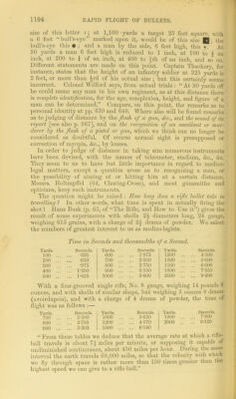
![size of this letter 1; at 1,100 yards a target 25 feet square, with a 6 feet “bull’s-eye” marked upon it, would be of this size Q the bull’s-eye this • ; and a man by the side, 6 feet high, this ?. At 50 yards a man G feet high is reduced to 1 inch, at 100 to \ an inch, at 200 to i of an inch, at 400 to |th of an inch, and so on. Different statements are made on this point. Captain Thackery, for instance, states that the height of an infantry soldier at 325 yards is 2 feet, or more than l5rd of his actual size; but this certainly seems incorrect. Colonel Wilford says, from actual trials : “At 50 yards off he could name any man in his own regiment, as at this distance there is complete identification, for the age, complexion, height, and figure of a man can be determined.” Compare, on this point, the remarks as to personal identity at pp. 639 and 640. Where also will be found remarks as to judging of distance by the flash of a gun, &c., and the sound of its report [see also p. 967], and on the recognition of an assailant or mur- derer by the flash of a pistol or gun, which we think can no longer be considered as doubtful. Of course normal sight is presupposed or correction of myopia, Ac., by lenses. In order to judge of distance in taking aim numerous instruments have been devised, with the names of teleometer, stadium, Ac., Ac. They seem to us to have but little importance in regard to medico- legal matters, except a question arose as to recognizing a man, or the possibility of aiming at or hitting him at a certain distance. Messrs. Holtzapffel (64, Charing-Cross), and most gunsmiths and opticians, keep such instruments. The question might be raised : IIow long does a rifle bullet take in travelling ? In other words, what time is spent in actually firing the shot! Hans Busk (p. 65, of “The Rifle, and How to Use it”) gives the result of some experiments with shells 2-g diameters long, 24 gauge, Aveighing 615 grains, with a charge of drams of powder. We select the numbers of greatest interest to us as medico-legists. Time in Seconds and thousandths of a Second. Yards. Seconds. 100 ... ... -325 200 ... ... '650 300 ... ... -975 400 ... ... 1-300 500 .. ... 1-625 Yards. Seconds. 600 ... ... 1-975 700 ... ... 2-350 800 ... ... 2'750 900 ... ... 3-160 1000 ... ... 3-600 Yards. Seconds. 1200 4-500 1300 5-000 1500 6-000 1800 7950 2000 9-400 With a four-grooved single rifle, No. 8 gauge, weighing 14 pouuds 8 ounces, and with shells of similar shape, but weighing 3 ounces 8 drams (avoirdupois), and with a charge of 4 drams of powder, the time of flight was as follows :— Yards. Seconds. 700 2-380 800 2-785 900 3-203 Yards. Seconds. 1000 3-620 1200 4-570 1500 6-140 Yards. Seconds. 1800 7-900 2000 9-120 “ From these tables we deduce that the average rate at which a rifle- ball travels is about 7£ miles per minute, or supposing it capable of undiminished continuance, about 450 miles per hour. During the same interval the earth travels 68,000 miles, so that the velocity with which Ave fly through space is rather more than 150 times greater than the highest speed Ave can give to a rifle-ball.”](https://iiif.wellcomecollection.org/image/b21907869_1144.jp2/full/800%2C/0/default.jpg)