A handy-book of forensic medicine and toxicology / by W. Bathurst Woodman and Charles Meymott Tidy.
- Date:
- 1877
Licence: Public Domain Mark
Credit: A handy-book of forensic medicine and toxicology / by W. Bathurst Woodman and Charles Meymott Tidy. Source: Wellcome Collection.
Provider: This material has been provided by the Royal College of Physicians of Edinburgh. The original may be consulted at the Royal College of Physicians of Edinburgh.
1151/1268 (page 1115)
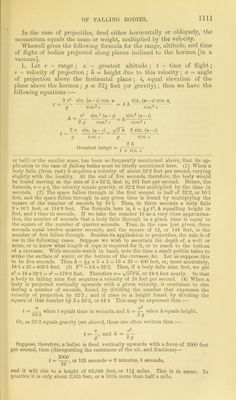
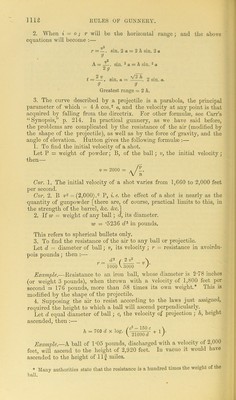
![In the case of projectiles, fired either horizontally or obliquely, the momentum equals the mass or weight, multiplied by the velocity. Whewell gives the following formula for the range, altitude, and time of flight of bodies projected along planes inclined to the horizon [in a vacuum]. 1. Let r = range; a = greatest altitude; t = time of flight; v — velocity of projection; h = height due to this velocity; a = angle of projection above the horizontal plane; i, equal elevation of the plane above the horizon; g — ?>2's feet (or gravity); then we have the following equations :— r = 2 v'2 sin. (a— i) cos. a 9 A= JL. = ih sin. (a— i) cos. a sin.2 (a —t) sin.2 (a— i) 2 v t = — 9 2 9 sin. cos.- ■ -0. h- y/2 k 2 sin. (a—i) cos. t 9 COS. t Greatest range = y 2 h x sin. <’ or ball) or the smaller mass, has been so frequently mentioned above, that its ap- plication to the case of falling bodies must be briefly mentioned here. (1) When a body falls (from rest) it acquires a velocity of about 32’2 feet per second, varying slightly with the locality. At the end of five seconds, therefore, the body would be found moving at the rate of 5 x 32-2, that is, 161 feet per second. Hence, the formula, v = g t, the velocity equals gravity, or 32'2 feet multiplied by the time in seconds. (2) The space fallen through in the first second is half of 32-2, or 16T feet, and the space fallen through in any given time is found by multiplying the square of the number of seconds by 16T. Thus, in three seconds a body falls 9 x 16T feet, or 144-9 feet. The formula here is, h = \g t‘, h equalling height in feet, and t time in seconds. If we take the number 16 as a very close approxima- tion, the number of seconds that a body falls through in a given time is equal to the square of the number of quarter seconds. Thus, in the case just given, three seconds equal twelve quarter seconds, and the square of 12, or 144 feet, is the number of feet fallen through. Besides its application to projectiles, the rule is of use in the following cases. Suppose we wish to ascertain the depth of a well or mine, or to know what length of rope is required for it, or to reach to the bottom of a crevasse. With seconds-watch in hand, note the time a small pebble takes to strike the surface of water, or the bottom of the crevasse, &c. Let us suppose this to be five seconds. Then h = \g *. 6x6=16x 25= 400 feet, or, more accurately, 16T x 25 = 402’5 feet. (3) V2 = 2 /i x 32'2. Thus, if a body falls nine feet, we get r2 = 18 x 32-2 = v2 = 579‘6 feet. Therefore v= \/57'J'0, or 24'6 feet nearly. So that a body in falling nine feet acquires a velocity of 24 feet per second. (4) When a body is projected vertically upwards with a given velocity, it continues to rise during a number of seconds, found by dividing the number that expresses the velocity of projection by 32-2 ; and it rises to a height found by dividing the square of that number by 2 x 32-2, or 64-4 This may be expressed thus :— V - V“ t = .j— when t equals time in seconds, and h = —- when h equals height. A y Or, as 32-2 equals gravity (see above), these are often written thus :— t = v j v2 —, and h = -x— 9 2 9 Suppose, therefore, a bullet is fired vertically upwards with a force of 2000 feet per second, then (disregarding the resistance of the air, and fractions)— _ 2000 32 ' or 125 seconds = 2 minutes, 5 seconds, and it will rise to a height of 62,500 feet, or 11 g miles. This is in vacuo. In practice it is only about 2,920 feet, or a little more than half a mile.](https://iiif.wellcomecollection.org/image/b21907869_1151.jp2/full/800%2C/0/default.jpg)