A handy-book of forensic medicine and toxicology / by W. Bathurst Woodman and Charles Meymott Tidy.
- Date:
- 1877
Licence: Public Domain Mark
Credit: A handy-book of forensic medicine and toxicology / by W. Bathurst Woodman and Charles Meymott Tidy. Source: Wellcome Collection.
Provider: This material has been provided by the Royal College of Physicians of Edinburgh. The original may be consulted at the Royal College of Physicians of Edinburgh.
1152/1268 (page 1116)
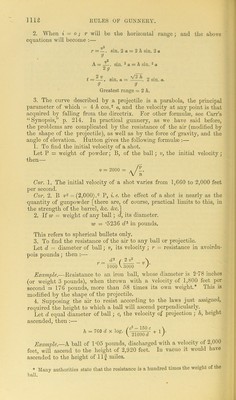
![2. When i = o; r will be the horizontal range; and the above equations will become :— r = —. sin. 2 a = 2 h sin. 2 a 9 A = sin. 2 a = h sin. 5 a 2? t 2v 9 ' sin. a \/2A S' 2 sin. a. Greatest range = 2h. 3. The curve described by a projectile is a parabola, the principal parameter of which = 4 h cos.2 a, and the velocity at any point is that acquired by falling from the directrix. For other formulae, see Carr’s “Synopsis,” p. 214. In practical gunnery, as we have said before, the problems are complicated by the resistance of the air (modified by the shape of the projectile), as well as by the force of gravity, and the angle of elevation. Hutton gives the following formulae :— 1. To find the initial velocity of a shot. Let P = weight of powder; B, of the ball; v, the initial velocity; then— Cor. 1. The initial velocity of a shot varies from 1,660 to 2,000 feet per second. Cor. 2. B v2 = (2,000).2 P, i. e. the effect of a shot is nearly as the quantity of gunpowder [there are, of course, practical limits to this, in the strength of the barrel, Ac. Ac.] 2. If w = weight of any ball; d, its diameter. w = -5236 d3 in pounds. This refers to spherical bullets only. 3. To find the resistance of the air to any ball or projectile. Let d = diameter of ball; v, its velocity ; r = resistance in avoirdu- pois pounds; then:— loooVaooo / Example.-—Resistance to an iron ball, whose diameter is 2-78 inches (or weight 3 pounds), when thrown with a velocity of 1,800 feet per second =176 pounds, more than 58 times its own weight.* This is modified by the shape of the projectile. 4. Supposing the air to resist according to the laws just assigned, required the height to which a ball will ascend perpendicularly. Let d equal diameter of ball; c, the velocity of projection ; h, height ascended, then:— Example.—A ball of L05 pounds, discharged with a velocity of 2,000 feet, will ascend to the height of 2,920 feet. In vacuo it would have ascended to the height of Ilf miles. * Many authorities state that the resistance is a hundred times the weight of the ball.](https://iiif.wellcomecollection.org/image/b21907869_1152.jp2/full/800%2C/0/default.jpg)