A handy-book of forensic medicine and toxicology / by W. Bathurst Woodman and Charles Meymott Tidy.
- Date:
- 1877
Licence: Public Domain Mark
Credit: A handy-book of forensic medicine and toxicology / by W. Bathurst Woodman and Charles Meymott Tidy. Source: Wellcome Collection.
Provider: This material has been provided by the Royal College of Physicians of Edinburgh. The original may be consulted at the Royal College of Physicians of Edinburgh.
1172/1268 (page 1136)
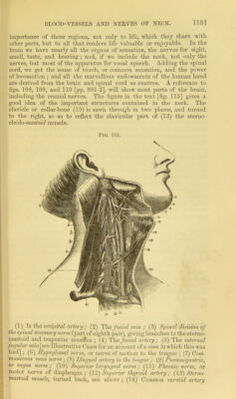
![[from which the external and interval carotids are derived]; (15) Clavicle or collar-bone, turned back, sec above; (1G) Stemo-hyoid muscle; (17) Sub-clavius muscle; (18) Omo-hyoid muscle; (1‘J) Thyroid axis, from sub-clavian artery ; (20) Middle cervical ganglion of the sympathetic nerve; (21) Sub-clavian artery. [This drawing is by J. T. Gray, and is the same as that given by Dr. Taylor, p. 488.] Severe suicidal or murderous wounds of the throat often involve the greater number of the structures named, on one or both sides of the neck. For the sake of system we must, however, treat first of— Injuries to the Head, including Concussion and Compression of the Brain. As the two last-named conditions are common to many forms of cerebral injury, and may be associated with wounds and fractures, or exist independent of any external marks of injury, it will be convenient to notice them before describing the other lesions. We will begin with— 1. Concussion of the Brain.—This is liable to be confused with intoxication, with compression of the bi'ain, with opium-poisoning, syncope, coma from vai’ious conditions, sun-stroke, &c. &c. It is a very common result of sudden injuries to the head, such as a violent blow, or a fall in which the head is struck. There need be no external wound. The symptoms are not unlike those of shock in injury to other oi’gans, or collapse, only that in concussion consciousness either is, or appears to be entirely lost at first, and suspended for a considerable time. The symptoms may come on immediately, and generally do so. In other cases tliex-e is a short interval between the accident and the supervexxtion of the symptoms. Drixitt * makes two degrees of it. “ (1) In ordinary cases the patient lies for a time motionless, uncon- scious, and insensible. If roused and qxxestioned, he answers hastily, and again relapses into insensibility. After a time he moves his limbs, as if in uneasy sleep, and vomits; and frequently x-ecovers his senses instantly afterwards; remaining, however-, giddy, confused, and sleepy for some hoxxrs. “ (2) In the more severe degx-ee the patient is profoundly insensible, surface pale and cold, the featmes ghastly, the pulse feeble and intermittent, or pex-haps insensible, and the bx-eathing slow, or per- formed only by a feeble sigh, drawn at intervals. Vomiting is an important symptom. It is not px-esent in very slight cases, nor in very sevex-e ones; and its occux-rence is mostly an indication of approaching recovery.” This condition may terminate fatally, after a few hoxxrs, or after some days. It really means contusion, as Mr. Prescott Hewett and Dx\ Druitt insist. Dr. Bright long ago pointed out minute ecchymoses, the size of pins’ heads, in fatal cases of this kind. There is also more or less laceration of the brain sxxbstance ; and injuries of the spine, and of other organs, such as the heart, are often found associated with it. Or there may be recovery, with but little damage, except headache, and slight fever for a few days. Or prolonged insensibility may last for many days, * “ Sux-geon’s Yade Mccum,” p. 333.](https://iiif.wellcomecollection.org/image/b21907869_1172.jp2/full/800%2C/0/default.jpg)