A handy-book of forensic medicine and toxicology / by W. Bathurst Woodman and Charles Meymott Tidy.
- Date:
- 1877
Licence: Public Domain Mark
Credit: A handy-book of forensic medicine and toxicology / by W. Bathurst Woodman and Charles Meymott Tidy. Source: Wellcome Collection.
Provider: This material has been provided by the Royal College of Physicians of Edinburgh. The original may be consulted at the Royal College of Physicians of Edinburgh.
38/1268
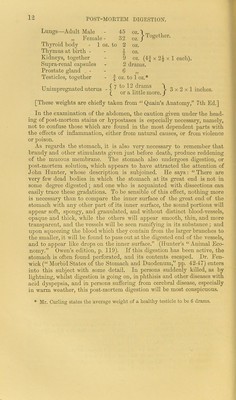
![POST-MORTEM DIGESTION. 1 o JL <v Lungs—Adult Male „ Female - Thyroid body - 1 oz. Thymus at birth - Kidneys, together Supra-renal capsules Prostate gland . - Testicles, together 45 oz. \ rp , 32 oz. / r°gcther- to 2 oz. 1 oz. 9 oz. (4| x 2J x 1 each). 2 drams. f oz. to 1 oz.* Unimpregnated uterus - l7 to 12 drams or a little more. } 3x2x1 inches. [These weights are chiefly taken from “ Quain’s Anatomy,” 7th Ed.] In the examination of the abdomen, the caution given under the head- ing of post-mortem stains or hypostases is especially necessary, namely, not to confuse those which are found in the most dependent parts with the effects of inflammation, either from natural causes, or from violence or poison. As regards the stomach, it is also very necessary to remember that brandy and other stimulants given just before death, produce reddening of the mucous membrane. The stomach also undergoes digestion, or post-mortem solution, which appears to have attracted the attention of John Hunter, whose description is subjoined. He says: “There are very few dead bodies in which the stomach at its great end is not in some degree digested; and one who is acquainted with dissections can easily trace these gradations. To be sensible of this effect, nothing more is necessary than to compare the inner surface of the great end of the stomach with any other part of its inner surface, the sound portions will appear soft, spongy, and granulated, and without distinct blood-vessels, opaque and thick, while the others will appear smooth, thin, and more transparent, and the vessels will be seen ramifying in its substance ; and upon squeezing the blood which they contain from the larger branches to the smaller, it will be found to pass out at the digested end of the vessels, and to appear like drops on the inner surface.” (Hunter’s “ Animal Eco- nomy.” Owen’s edition, p. 119). If this digestion has been active, the stomach is often found perforated, and its contents escaped. Dr. Fen- wick (“ Morbid States of the Stomach and Duodenum,” pp. 42-47) enters into this subject with some detail. In persons suddenly killed, as by lightning, whilst digestion is going on, in phthisis and other diseases with acid dyspepsia, and in persons suffering from cerebral disease, especially in warm weather, this post-mortem digestion will be most conspicuous.](https://iiif.wellcomecollection.org/image/b21907869_0038.jp2/full/800%2C/0/default.jpg)