Grammar and dictionary of the language of the Hidatsa : (Minnetarees, Grosventres of the Missouri) : with an introductory sketch of the tribe / by Washington Matthews.
- Washington Matthews
- Date:
- 1873-1874
Licence: Public Domain Mark
Credit: Grammar and dictionary of the language of the Hidatsa : (Minnetarees, Grosventres of the Missouri) : with an introductory sketch of the tribe / by Washington Matthews. Source: Wellcome Collection.
160/176 (page 146)
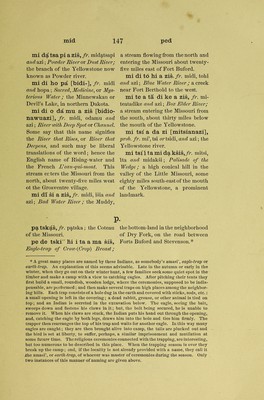
![m. ma e tsi a zis, fr. maetsi and azi; Knife River; a name applied to two streams, one of which enters the Missouri from the north, above Fort Berthold, and the other from the south, below that place. ma ka di sta ti, fr. makadista and ati; House of the Infants; a cavern near the old villages on Knife river, supposed to be inhabited by mysterious infants* ** ma o de saa zi[-ne-],/r. mao- desa, and azi; Nothing River or Nameless River; an affluent of the Little Missouri, entering the latter about one hundred miles above its mouth. ma p6 ksa a ti, fr. mapoksa and ati; Snake House; a cave near the Missouri river, on the north or left bank, close to Snake creek. It is said, at some seasons to swarm with serpents. ma p6 ksa a ti a zi [-zis], Snake House River. So called by these Indians ; but Lewis and Clark have given the name as “ Snake creek,” and it has been thus known to the whites ever since. It enters the Missouri five miles east cf Fort Stevenson, Dakota Territory. ma su ka ak su a ma sis, fr. masukaaksu and amasi; Earth-trap, or Eagle-trap, of Coral Berry; a point on the left bank of the Mis- souri, immediately below the upper Great Bend. See note, p. 147. ma ta ki a zis, Dish River; Platte river, Nebraska. ma tsu a zi [-zis], fr. matsu and azi; Cherry River; a stream which enters the Little Missouri from the east, above the maode- saazis. ma u' pa ki hu pa i sis, fr. maupaki, hupa and isis; Like the Handle of a Mallet; a prominent bluff on the south side of the Mis- souri, nearly opposite the mouth of upper Knife river. mi da i' si a zis, fr. midaisi and azi; Bark River; a stream which enters the Missouri from the south above the Yellowstone. * The door of the cavern was hut a span wide. It was said, that if you visited the cavern after a rainyyiight, you could see the tracks of the infants where they went to a distance from the cave and returned. Their belief concerning the fabled children was as followsIt was difficult to see them, for they came out only at night and followed a wise leader who knew the scent of man and shunned his observation. The childless husband, after a long fast, would repair to the neighborhood of the cave at night and secrete himself behind a boul- der to the leeward to watch; if he saw the infants, he returned home, confident that he would be a father within a year. The barren wite who desired children would, at sunset, lay at the mouth of the cave a tiny play-ball and a little bow and arrow. If the ball was missing in the morning, she believed that within a year she would be the mother of a girl; while if the bow and arrow were missing, she supposed she would be the mother of a boy. If neither were “ taken,” she went back with little hope; and could not consult the oracle again until a year had elapsed. They had many other beliefs connected with the cavern. Since the removal of the Hidatsa to their present residence, the custom of visiting the cave has been abandoned.](https://iiif.wellcomecollection.org/image/b2487372x_0160.jp2/full/800%2C/0/default.jpg)