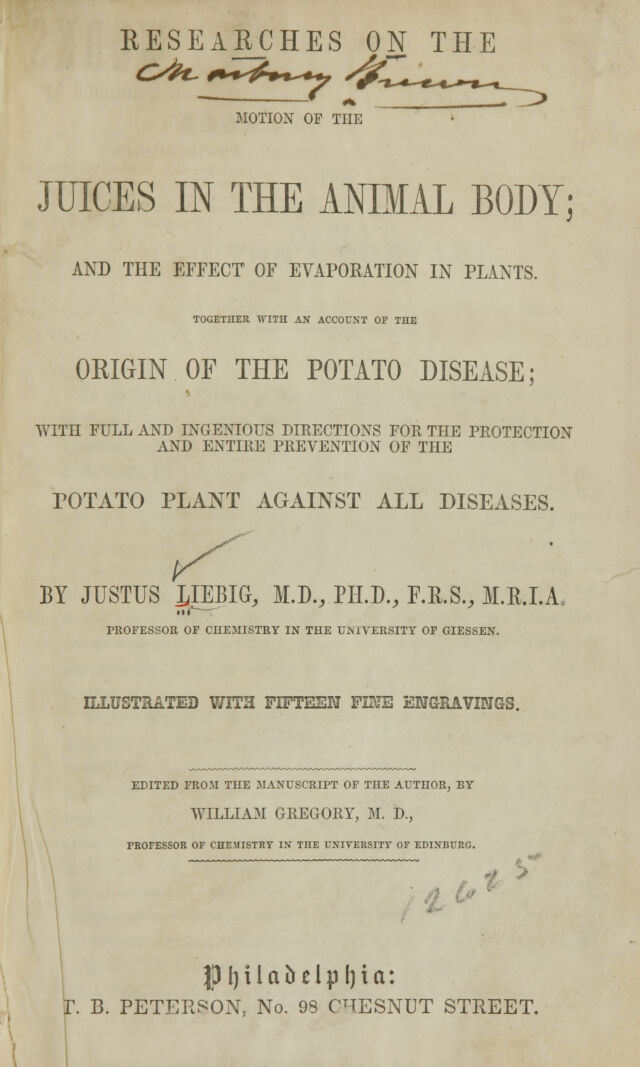
Researches on the motion of the juices in the animal body : and the effect of evaporation in plants : together with an account of the origin of the potato disease, with full and ingenious directions for the protection and entire prevention of the potato plant against all diseases / by Justus Liebig ; edited from the manuscript of the author by William Gregory.
- Justus von Liebig
- Date:
- [1850?]
Licence: Public Domain Mark
Credit: Researches on the motion of the juices in the animal body : and the effect of evaporation in plants : together with an account of the origin of the potato disease, with full and ingenious directions for the protection and entire prevention of the potato plant against all diseases / by Justus Liebig ; edited from the manuscript of the author by William Gregory. Source: Wellcome Collection.
Provider: This material has been provided by the National Library of Medicine (U.S.), through the Medical Heritage Library. The original may be consulted at the National Library of Medicine (U.S.)
27/52
![particles, it is impossible to explain how water and brine can move in the same tube with unequal velocity in opposite directions; the two liquids being supposed to have a mutual attraction, that is, to be miscible. This attraction must act with- in the tube just as well without; and we might, therefore, suppose, that when the two liquids have become mixed, the mixture could only move in one direction with a medium velocity. Assuming that a mixture is formed in the open orifices of the pores or tubes, or in any part of them, it is difficult to see, why saline particles should not pass from one side to the water, or aqueous particles to the saline ones in the bladder, since the mutual attraction must be regarded as equal on both sides. The chemical affinity of the two liquids does not explain the efflux. If we suppose, that in certain pores only brine, in others only pure water moves, the phenomenon ought not to occur when all the pores are filled with Avater or with brine, or when the tube is tied with a double, treble, or fourfold, bladder. But the properties of bladder are seen in the finest as well as thickest membranes, and one, two, or three layers make no difference in the ultimate result.^) The kind of influence which the nature of the partition, or its attraction for the liquids in contact with it, exerts on the phenomenon, is seen by comparing the action of an animal membrane with that of a thin sheet of caoutchouc* In a tube, closed with bladder, which is filled with alcohol, and immersed in pure water, the volume of alcohol is increased; more water passes to the alcohol than alcohol to the water.t If, without making any other change in the experiment, the tube be closed with a thin sheet of caoutchouc, the volume of the alcohol now diminishes while that of the water increases. Here, all the circumstances of the mixture of the two liquids have remained the same except the nature of the partition, which makes the difference in the result. When we fill with brine a tube, closed with bladder, (Fig. 8,) r- g and place it in a vessel of water, so that the bladder and water only communicate by a single drop, the liquid in the tube increases in bulk, and rises in the tube, as if the bladder had been immersed in the water; but the drop becomes gradually smaller, till after an hour or two, a complete separation takes place, and the drop tears itself away from the water. (2) If the cause of the change of volume in this experiment were the unequal resistance which the bladder opposes to the passage of the two liquids with equal attraction (equal force) on both sides, the phenomenon just described would be inexplicable ; for a resistance can no doubt impede, but is not capable of producing motion. But we see, that the water in this experiment is raised to a higher level, and moreover, the tearing asunder of the drop can only be the effect of a powerful attraction, residing in the substance of the bladder. (') With respect to the theory, that, when a saline solution is mixed with pure ■water, if the two liquids are separated by a membrane, particles of salt alone pass through the pores of the bladder to the water, and particles of water alone to the brine, the following experiments may throw some light on the question. For the sake of greater accuracy, the results were determined by weighing. The apparatus, Fig. 3, was used. The tube contained 8-67 grammes of saturated brine, in which were 2-284 gram- mes of salt and 6-38 of water. After 24 hours it had gained F79 grammes in weight, and it now contained only 0-941 grammes of salt. It had therefore lost 1*343 grammes of salt, and gained 3 13 of water. According to the above theory, 1 atom of salt and [2] If we pour into a tube, } of an inch wide, and closed with bladder, as much mercury as covers the surface of the bladder, then fill it with brine, and place it in pure water, the volume of the liquid in the tube increases exactly as if the mercury were not there. * The nature of the membrane has an important influence, t Experiment with bladder, and with caoutchouc. 4](https://iiif.wellcomecollection.org/image/b21136944_0027.jp2/full/800%2C/0/default.jpg)