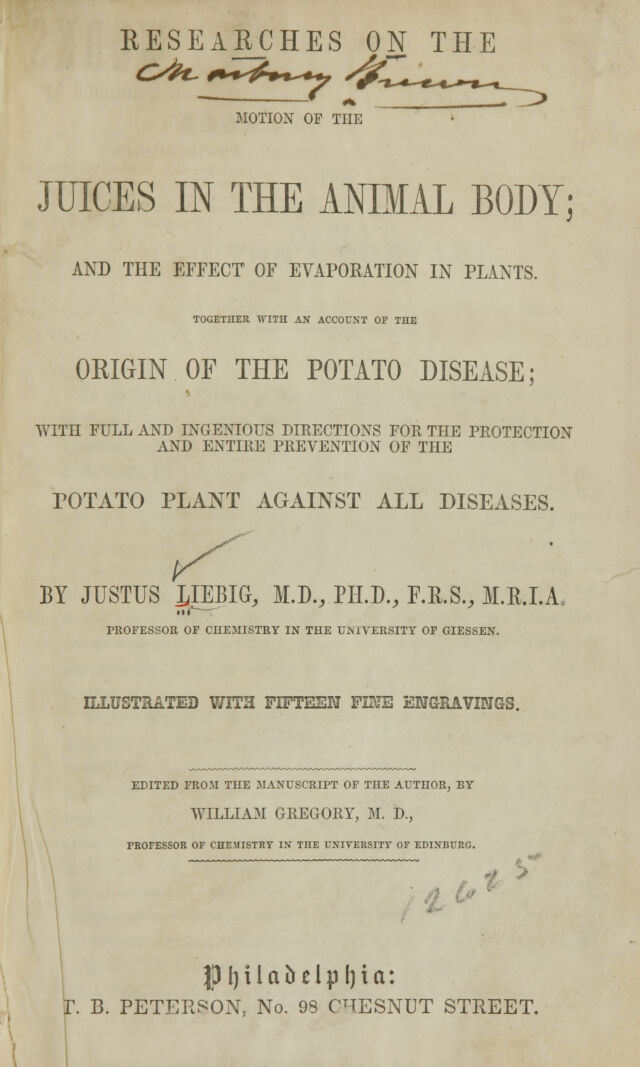
Researches on the motion of the juices in the animal body : and the effect of evaporation in plants : together with an account of the origin of the potato disease, with full and ingenious directions for the protection and entire prevention of the potato plant against all diseases / by Justus Liebig ; edited from the manuscript of the author by William Gregory.
- Justus von Liebig
- Date:
- [1850?]
Licence: Public Domain Mark
Credit: Researches on the motion of the juices in the animal body : and the effect of evaporation in plants : together with an account of the origin of the potato disease, with full and ingenious directions for the protection and entire prevention of the potato plant against all diseases / by Justus Liebig ; edited from the manuscript of the author by William Gregory. Source: Wellcome Collection.
Provider: This material has been provided by the National Library of Medicine (U.S.), through the Medical Heritage Library. The original may be consulted at the National Library of Medicine (U.S.)
30/52
![through them.* These phenomena may be produced with clay cells (J) (such as are used for galvanic apparatus;) with the lining membrane of the pods of peas and beans ; with the fine inner bark of trees ; with the skin of grapes, of potatoes, of apples ; with the inner membrane of the capsules of bladder senna, &c.; but animal tissues surpass all others in efficacy. Besides their unequal affinity, they have an unequal absorbent power for dissimilar liquids, by which their action in causing change of volume during mixture is strengthened. When a tube, closed with bladder, and filled with water, is immersed in alcohol or brine, there is produced at all points, where the brine or the alcohol comes in contact with bladder saturated with water, a change in the properties of the bladder.t When, in the open pores, the alcohol or brine mixes with the water already there, the absorbent power of the bladder for the water is diminished; a smaller volume of the mixture is retained than of pure water; that is to say, water flows out in the direction of the alcohol or brine. This efflux is accompanied by a change in the volume of the substance of the bladder, for that side of it which is towards the alcohol or the brine contracts or shrinks. The opposite surfaces of an animal membrane, in contact with dissimilar liquids, for which they have unequal absorbent power, are in an unequal state of contraction. This condition is permauent, as long as the liquids do not change in their proper- ties ; but it ceases, in consequence of mixture, and is again restored, when, by means, of the change of place in both the liquids which are in contact with the opposite sur- faces of the bladder, the original or any other permanent inequality or difference of properties is produced. In all cases where a permanent change in the volume of two liquids, separated by a membrane, is observed during their mixture, it is always accompanied by a permanent difference in the nature or properties of the two liquids; and from this it follows, that the molecules of the animal membrane must be, during the mixture, in an alternate state of contraction and swelling, or dilatation ; that is, in a continual motion.% From what has been stated, it appears that the change of volume of two miscible liquids, separated by a membrane, is determined by the unequal capacity of being moistened, or the unequal attraction of the membrane for these liquids. The une- qual absorbent power of the membrane for these liquids depends on the dissimilar nature of the liquids or of the substances dissolved in them. An unequal proportion (') I consider it of sufficient importance to state here that porous clay also takes up unequal volumes of brine and water. In special experiments made on this subject, cells of clay (moderately ignited porcelain biscuit) were laid for 24 hours in pure water] then carefully dried externally with bibulous paper, and the increase in weight, that is] the weight of the absorbed water, carefully determined.$ The clay was the°i carefully dried, laid for 24 hours in brine, and the weight of the absorbed brine determined in like manner. In a secpnd series of experiments, the clay cells were steeped in water and brine, and placed in the receiver of the air-pump, under a pressure of 8 lines of mercury (^ of an inch) for 24 hours. Under the ordinary pressure, and in air the cells absorbed— Weight. Volume. 1Ar. „ , , Water. Brine. Water. Brine 100 parts of clay cell I.—15'4 14-6 15-4 \9-o II.—11-8 11-6 11-8 9-7 In vacuo the cells of clay absorbed— Weight. Volume. ^nn . . ,, Water. Brine. Water. Brine. 100 parts of clay cell absorbed I.—16-5 16-8 16-5 14-0 II.—13-8 13-8 13-8 11-5 * Porous bodies in general exhibit similar phenomena. T Bladder shrinks in contact with brine or alcohol. «.i»?«n^i,of V0Junie K,two liquids, separated bv membrane, is accompanied bv continual lor the irqSdesPaniCleS °f the membrane 5 and Spends on the unequal attraction of the membrane $ Amount of liquids absorbed by porous baked ciay.](https://iiif.wellcomecollection.org/image/b21136944_0030.jp2/full/800%2C/0/default.jpg)