The absorption of oxygen by the lungs / by J. Haldane and J. L. Smith.
- John Scott Haldane
- Date:
- [1897]
Licence: Public Domain Mark
Credit: The absorption of oxygen by the lungs / by J. Haldane and J. L. Smith. Source: Wellcome Collection.
Provider: This material has been provided by The University of Glasgow Library. The original may be consulted at The University of Glasgow Library.
3/30
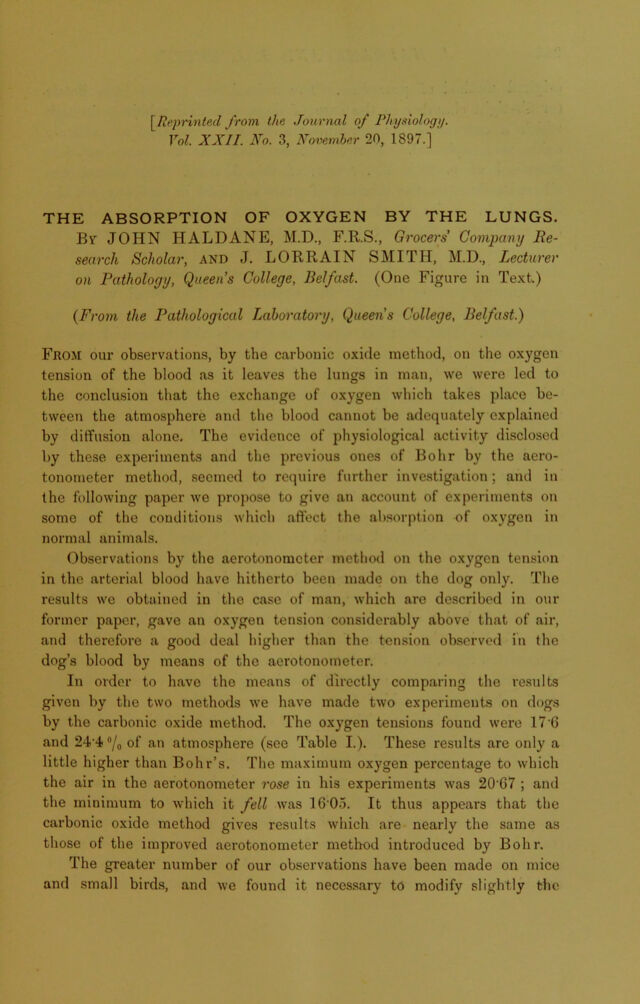
![[Reprinted from the Journal of Physiology. Vol. XXII. No. 3, November 20, 1897.] THE ABSORPTION OF OXYGEN BY THE LUNGS. By- JOHN HALDANE, M.D., F.R.S., Grocers Company Re- search Scholar, and J. LORRAIN SMITH, M.D., Lecturer on Pathology, Queens College, Belfast. (One Figure in Text,) (From the Pathological Laboratory, Queens College, Belfast.) From our observations, by the carbonic oxide method, on the oxygen tension of the blood .as it leaves the lungs in man, we were led to the conclusion that the exchange of oxygen which takes place be- tween the atmosphere and the blood cannot be adequately explained by diffusion alone. The evidence of physiological activity disclosed by these experiments and the previous ones of Bohr by the aero- tonometer method, seemed to require further investigation; and in the following paper we propose to give an account of experiments on some of the conditions which affect the absorption of oxygen in normal animals. Observations by the aerotonomcter method on the oxygen tension in the arterial blood have hitherto been made on the dog only. The results we obtained in the case of man, which are described in our former paper, gave an oxygen tension considerably above that of air, and therefore a good deal higher than the tension observed in the dog’s blood by means of the aerotonometer. In order to have the means of directly comparing the results given by the two methods we have made two experiments on dogs by the carbonic oxide method. The oxygen tensions found were 17 6 and 24 4 °/0 of an atmosphere (see Table I.). These results are only a little higher than Bohr’s. The maximum oxygen percentage to which the air in the aerotonometer rose in his experiments was 20 67 ; and the minimum to which it fell was 16 05. It thus appears that the carbonic oxide method gives results which are nearly the same as those of the improved aerotonometer method introduced by Bohr. The greater number of our observations have been made on mice and small birds, and we found it necessary to modify slightly the](https://iiif.wellcomecollection.org/image/b24930076_0005.jp2/full/800%2C/0/default.jpg)