Volume 1
The standard physician : a new and practical encyclopaedia of medicine and hygiene especially prepared for the household / edited by Sir James Crichton-Browne [and others].
- Date:
- 1908-1909
Licence: In copyright
Credit: The standard physician : a new and practical encyclopaedia of medicine and hygiene especially prepared for the household / edited by Sir James Crichton-Browne [and others]. Source: Wellcome Collection.
303/430 (page 277)
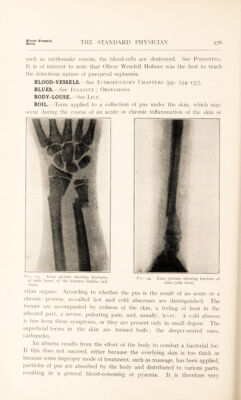
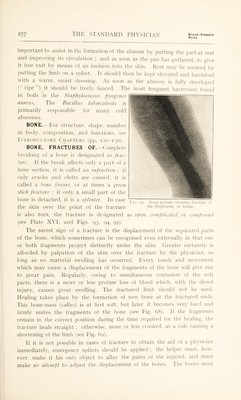
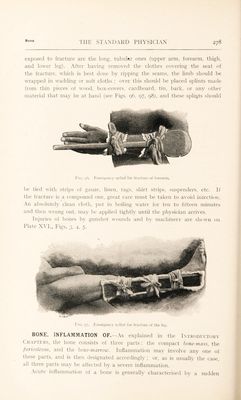
![Bone important to assist in tlu formation of the abscess by ])iitting the j-iart at rest and impio\ing its ciiculation j and as soon as the ])iis has gathered, to give it free exit l)y means of an incision into the skin. Rest may l)c secured l)y putting tlie liml) on a splint. It should then be kept elevated and furnished with a warm, moist dressing. As soon as the abscess is fully developed (“ ripe ”) it should be freely lanced. The most frequent bacterium found in boils is the Staphylococcus pyogenes aureus. The Bacillus tuberculosis is primarily responsible for many cold abscesses. BONE.—For structure, shape, number in body, composition, and functions, see Introductory Chapters (pp. 120-iqo). BONE, FRACTURES OF.—Complete breaking ol a bone is designated as frac- ture. If the break affects onh’ a ])art of a bone section, it is called an i)ifraction : if only cracks and clefts are caused, it is called a hone fissure, or at times a green stick fracture ; if only a small ])art of the bone is detached, it is a splinter. In case the skin over the point of the fracture is also torn, the fracture is designated as open, coni plicated, or compound (see Plate X\T. and Figs. 93, 94, 95). The surest sign of a fracture is the displacement of the se})arated })arts of the bone, which sometimes can be recognised even externally in that one or both fragments project distinctly under the skin. (Greater certainty is afforded by palpation of the skin over the fracture by the physician, so long as no material swelling has occurred. Fvery touch and movement which may cause a displacement of the fragments of the bone will give rise to great pain. Regularly, owing to simultaneous contusion ot the soil parts, there is a more or less profuse loss of blood which, with the direct injury, causes great swelling. The fractured limb should not be used. Healing takes place by the formation of new bone at the fractured ends. This bone-mass (callus) is at first soft, but later it becomes very hard and firmly unites the fragments of the bone (see big. 68). If the fragments remain in the correct position during the time required for the healing, the fracture heals straight ; otherwise, more or less crooked, as a rule causing a shortening of the limb (see Fig. 69). If it is not possible in cases of fracture to obtain the aid of a physician immediately, emergency siilints should be applied ; the helper must, how- ever, make it his only object to allay the pains of the injured, and must make no attempt to adjust the displacement of the bones. The bones most](https://iiif.wellcomecollection.org/image/b29000865_0001_0305.jp2/full/800%2C/0/default.jpg)