Volume 1
The standard physician : a new and practical encyclopaedia of medicine and hygiene especially prepared for the household / edited by Sir James Crichton-Browne [and others].
- Date:
- 1908-1909
Licence: In copyright
Credit: The standard physician : a new and practical encyclopaedia of medicine and hygiene especially prepared for the household / edited by Sir James Crichton-Browne [and others]. Source: Wellcome Collection.
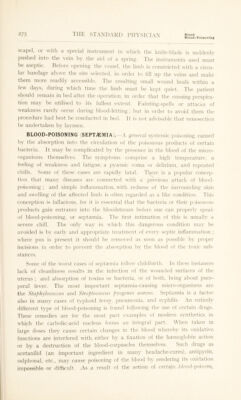
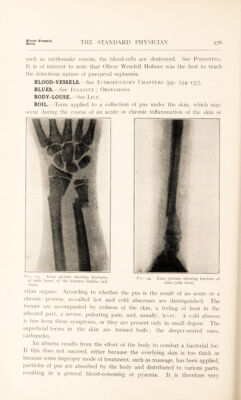
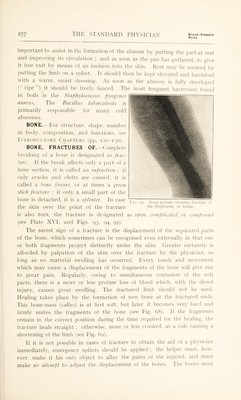
305/430 (page 279)
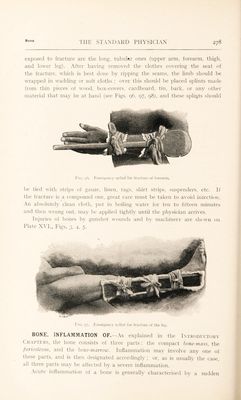
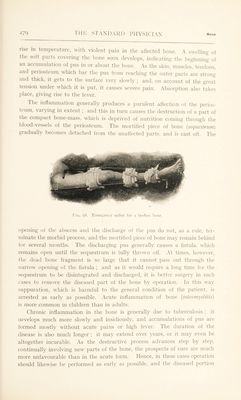
![Z-Ji) 'I'lll-: S'l'ANDAKl) PHVSK'IAX lise in temperature, with violent j)ain in the affected bone. .\ swelling of the soft parts covering the bone soon develops, indicating the beginning of an accumulation of pus in or about the bone. As the skin, muscles, tendons, and i')eriosteum which bar the pus trom reaching the outer parts are strong and thick, it gets to the suiiace ver\' slowly ; and, on account of the great tension undei which it is put, it causes severe pain. Absorption also takes l^lace, giving rise to the fever. The inflammation generally produces a purulent affection of the perios- teum, varying in e.xtent ; and this in turn causes the destruction of a part of the com])act bone-mass, which is de])rived of nutrition coming through the blood-vessels of the periosteum. The mortified ])iece of bone [sequestrum) gradually becomes detached from the unaffected parts, and is cast off. The I'lG. 9S. Enier.uency splint for a broken bone. opening oi the abscess and the discharge of the pus do not, as a rule, ter- minate the morbid process, and the mortified ])iece of bone may remain behind lor several months. The discharging pus generally causes a fistula, which remains open until the sequestrum is fully thrown off. At times, however, the dead bone fragment is so large that it cannot pass out through the narrow opening of the fistula ; and as it would recpiire a long time for the se(|uestruni to be disintegrated and discharged, it is better surgery in such cases to remove the diseased part of the bone by operation. In this way suppuration, which is harmful to the general condition of the patient, is arrested as earlv as possible. Acute inflammation of bone [osteomyelitis) is more common in children than in adults. Chronic inflammation in the bone is generally due to tuberculosis ; it develops much more slowly and insidiously, and accumulations of pus are formed mostly without acute pains or high fever. Ihe duration of the disease is also much longer ; it may extend over years, or it may even be altogether incurable. As the destructive process advances step by step, continually involving new parts of the bone, the prospects of cure are much more unfavourable than in the acute form. Hence, in these cases operation should likewise be performed as early as ]:)ossible, and the diseased portion](https://iiif.wellcomecollection.org/image/b29000865_0001_0307.jp2/full/800%2C/0/default.jpg)