Volume 1
The standard physician : a new and practical encyclopaedia of medicine and hygiene especially prepared for the household / edited by Sir James Crichton-Browne [and others].
- Date:
- 1908-1909
Licence: In copyright
Credit: The standard physician : a new and practical encyclopaedia of medicine and hygiene especially prepared for the household / edited by Sir James Crichton-Browne [and others]. Source: Wellcome Collection.
312/430 (page 286)
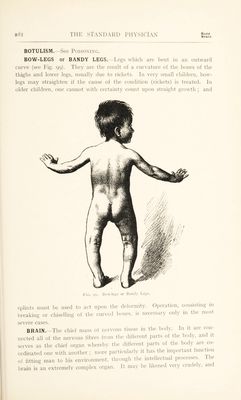
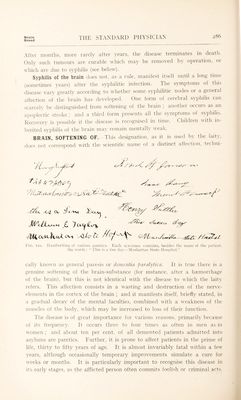
![Bread 286 After months, more rareh’ after years, the disease terminates in death. Only such tumours are curable which may be removed by opeiation, 01 which are due to syphilis (see below). Syphilis of the brain does not, as a rule, manilest itselt until a long time (sometimes years) after the syphilitic infection. The symptoms of this disease vary greatlv according to whether some, syphilitic nodes or a general affection of the brain has developed. One form of cerebral syj)hilis can scarcely be distinguished from soltening ot the brain ; anothei occuis as an a]M)plectic stroke ; and a third form ]n-esents all the symptoms ot svphihs. Recovery is ]K)ssible if the disease is recognised in time. Children with in- herited sy])hilis of the brain may remain mentally weak. BRAIN, SOFTENING OF. This designation, as it is used by the laity, does not correspond with the scientilic name ol a distinct affection, teclmi- A'T' I'lG. TOO. ]!aiidwritinqof various i)aretics. Kach si ecimen contains, Ixisides tin; name of tlu* i)atient. the words; ■''I'liis is a fine day—Manhattan State Hospital. cally known as general jniresis or dcnit’iiiia pavidytica. It is true there is a genuine softening of the brain-sul)stance (for instance, after a luemorrhage of the brain), but this is not identical with the disea.se to which the laity refers. This affection consists in a wasting and destruction of the ner\'e- clemcnts in the cortex of the brain ; and it manifests itself, bricfl}’ stated, in a gradual decay of the mental faculties, combined with a weakness of the muscles of the body, which may be increased to loss of their function. The disease is of great importance for various reasons. ]:)rimarily because of its frequency. It occurs three to four times as often in men as in women ; and about ten per cent, of all demented ])atients admitted into asvlums are paretics. Eurther, it is prone to affect patients in the ])rime of life, thirty to fifty years of age. It is almost invariably fatal within a few years, although occasionally temporary improvements simulate a cure for weeks or months. It is particularly important to recognise this disease in its. early stages, as the afflicted person often commits foolish or criminal acts.](https://iiif.wellcomecollection.org/image/b29000865_0001_0314.jp2/full/800%2C/0/default.jpg)