Volume 1
The standard physician : a new and practical encyclopaedia of medicine and hygiene especially prepared for the household / edited by Sir James Crichton-Browne [and others].
- Date:
- 1908-1909
Licence: In copyright
Credit: The standard physician : a new and practical encyclopaedia of medicine and hygiene especially prepared for the household / edited by Sir James Crichton-Browne [and others]. Source: Wellcome Collection.
314/430 (page 288)
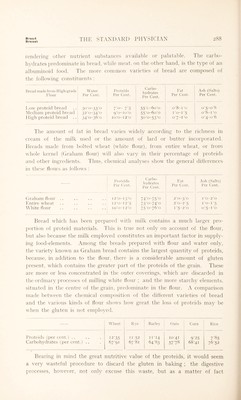
![Bread Breast Tin: STANDARD PHYSICIAN 288 rendering other nutrient substances available or |)alatabl(\ J he carbo- hydrates predominate in bread, while meat, on the other hand, is the type ot an albuminoid food. 'I'he more common varieties of bread are com})osed of the following constituents : llread made from 11 igh-^rade I'lour Water Per Cent. Proteids Per Cent. Carbo- liydrates I’er Cent. 1-at Per Cent. .Vsh (.Salts) Per Cent. I .ow proteid bread .Medium proteid bread II i” h proteid bread . . j 2'0-34-0 34'0-36'o 7'^^ 7'5 9‘u—lo'u lo’o-l 2'o 55'0-60'o 55-0-60-O 50'0-53-o ‘o 1 -o-l -5 07-1 '0 0-5-0-s o'S-t ■() o-4-(j‘6 'Idle amount of fat in bread varies widelv according to the richness in cream of the milk used or the amount of lard or butter incorjiorated. Dreads made from bolted wheat (white flour), from entire wheat, or from whole kernel ((rraham ilour) will also \'arv in their percentage of proteids and other ingredients. 'I'lius, chemical anah'ses show the general differences in these floui's as follows : — 1 'rofeids I’er Cent. Carbo- hydrates I’er Cent. T'at Per Cent. .Ash (.Salts) Per Cent. Ciraliam Hour . . I'hitire w heat White Hour I 2-0-13-0 1 2'o-I 2-5 lO'o-I 2-0 74'0-75'o 73 ’f>~74’o 75-0-76-0 2 -0-3 -0 2-0-2-5 I -5-2-0 I 0-2 -Q I -o-I 5 (P5-I -0 P)read wdiich has been ])re]iared with milk contains a much larger jiro- portion of proteid materials, ddiis is true not only on account of the flour, but also because the milk em])loved constitutes an important factor in supply- ing food-elements. Among the breads prepared with flour and water only, the variety knowui as Graham bread contains the largest quantity of proteids, because, in addition to the flour, there is a considerable amount of gluten jiresent, which contains the greater |)art of the proteids of the grain. These are more or less concentrated in the outer coverings, wdiich are discarded in the ordinary ]irocesses of milling wdiite flour ; and the more starchy elements, situated in the centre of the grain, jiredominate in the flour. A comparison made between the chemical composition of the dilferent varieties of bread and the various kinds of flour shows how great the loss of proteids may be wdien the gluten is not em]ilo\’ed. — Wheat }\ ye barley (tats Corn Rice I’roteid.s (percent.) .. Carbohydrates (per cent.) .. 12'33 67-91 TI 72 67-81 11-14 64-83 IO-4T 577^^ 9‘25 68-41 7 -85 76-52 Bearing in mind the great nutritive value of the proteids, it w’ould seem a very wasteful procedure to discard the gluten in baking ; the digestive processes, however, not only excuse this waste, but as a matter of fact](https://iiif.wellcomecollection.org/image/b29000865_0001_0316.jp2/full/800%2C/0/default.jpg)