Volume 1
The standard physician : a new and practical encyclopaedia of medicine and hygiene especially prepared for the household / edited by Sir James Crichton-Browne [and others].
- Date:
- 1908-1909
Licence: In copyright
Credit: The standard physician : a new and practical encyclopaedia of medicine and hygiene especially prepared for the household / edited by Sir James Crichton-Browne [and others]. Source: Wellcome Collection.
376/430 (page 346)
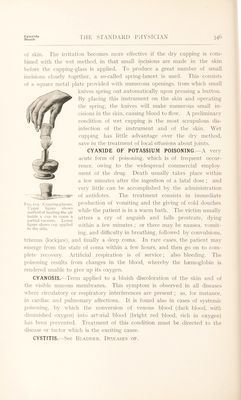
![Cyanide Death rHl£ STANDARD INIVSICIAX 34'> of skin. The irritation becomes more effective if the dry cupping is com- bined with the wet method, in that small incisions are made in the skin before the cupping-glass is applied. To produce a great number of small incisions closely together, a so-called spring-lancet is used. This consists of a square metal ])late provided with numerous openings, from which small knives spring out automatically upon pressing a button. By placing this instrument on the skin and operating the spring, the knives will make numerous small in- cisions in the skin, causing blood to flow. A preliminary condition of wet cupping is the most scrupulous dis- infection of the instrument and of the skin. Wet cup])ing has little advantage over the dry method, save in the treatment of local effusions about joints. CYANIDE OF POTASSIUM POISONING.—A very acute form of poisoning, which is of frequent occur- rence, owing to the widespread commercial employ- ment of the drug. Death usually takes place within a few minutes after the ingestion of a fatal dose ; and very little can be accomplished b}/ the administration of antidotes. The treatment consists in immediate production of vomiting and the giving of cold douches while the patient is in a warm bath. The victim usually utters a cry of anguish and falls prostrate, dying within a few minutes ; or there may be nausea, vomit- ing, and difficulty in breathing, followed by convulsions, trismus (lockjaw), and finally a deep coma. In rare cases, the patient may emerge from the state of coma within a few hours, and then go on to com- plete recovery. Artihcial respiration is of service; also bleeding. The poisoning results from changes in the blood, whereby the haemoglobin is rendered unable to give up its oxygen. CYANOSIS.—Term applied to a bluish discoloration of the skin and of the visible mucous membranes. This symptom is observed in all diseases where circulatory or respiratory interferences are present ; as, for instance, in cardiac and pulmonary affections. It is found also in cases of systemic poisoning, by which the conversion of venous blood (dark blood, with diminished oxygen) into arterial blood (bright red blood, rich in oxygen) has been prevented. Treatment of this condition must be directed to the disease or factor which is the exciting cause. CYSTITIS.—See Bl.\dder. Di^jEASES of. I'k;. 105. Cupping-glasses. Upper Hgiire shows method of heating the air inside a cui) to cause a ])artial vacuum. Lower figure shows cup applied to the skin.](https://iiif.wellcomecollection.org/image/b29000865_0001_0378.jp2/full/800%2C/0/default.jpg)