A research on the pines of Australia / by Richard T. Baker and Henry G. Smith.
- Baker, Richard Thomas, 1854-1941.
- Date:
- 1910
Licence: In copyright
Credit: A research on the pines of Australia / by Richard T. Baker and Henry G. Smith. Source: Wellcome Collection.
129/538 page 93
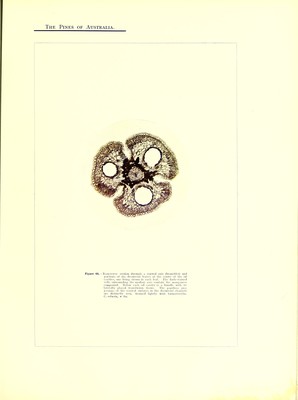
![edges of the assimilatory surfaces, which are backed by comparatively large epidermal cells, and much larger than the hypodermal. The palisade cells form a good marginal proportion of that part of the leaf substance. The clusters of dark patches at the base of the decurrent channels are the parenchymatous cells containing the manganese compound. In Figure 44 the chief feature of the section, taken just below the free ends of the leaf, is the amount of leaf space occupied by the oil cavity in each leaf, the secretory cells forming a distinct ling. Between the base of the decurrent channel and the central axis, it will be noticed that parenchymatous cells are closely packed, and having the man- ganese contents staining black. The trefoil formed by the three-leaf sections varies in shape as in other species. (c) Chemistry of the Leaf Oil. This material was forwarded by the Government of Western Australia, and was received on the 15th July, 1903. There were numerous fruits upon the branchlets, but these were removed and distilled separately. This oil is, therefore, that of the leaves with terminal branchlets only. The distillation was continued for six hours, and 287 lb. of material gave 12 oz. of oil, equal to 0-261 per cent. The crude oil was somewhat dark in colour, but it had the odour of the Callitris oils generally, particularly those containing a fair amount of the ester of borneol. Up to the present time (1910) it has not deposited a resin on the sides of the bottle, which result distinguishes it at once from all our samples of C. glauca and C. ver- rucosa. It is also distinguished from the oil of C. glauca by a considerably less rotation, a higher specific gravity, the presence of a sesquiterpene in small quantity, and a less yield. It was also, at this later date, soluble in 10 volumes of 80 per cent, alcohol by weight, and although somewhat less soluble in alcohol than when freshly distilled, yet it did not become insoluble like the crude oils of C. glauca. This fact probably accounts for the non-deposition of the insoluble resin. The oil contained a large amount of dextro-rotatory pinene, proved by its chemical combinations; and judging from the results of the specific gravity and the rotation of the larger fraction, together with the results of the redistillation, there is less limonene and dipentene in the oil of this species than in that of C. glauca and allied species. The ester content was fairly high for an oil of this group. It was found to consist principally of the mixed acetic acid esters of borneol and geraniol. It will be observed that the oil distilled from the fruits of this species had an optical rotation in the opposite direction to that from the leaves, and that the ester content was considerably less also. The specific gravity of the crude oil at 150 C. = 0-8825; rotation, [«]D = +- 10-3°; refractive index at 190 C. = 1-4752. The saponification number](https://iiif.wellcomecollection.org/image/b28085814_0129.jp2/full/800%2C/0/default.jpg)

 No text description is available for this image
 No text description is available for this image
 No text description is available for this image