Licence: In copyright
Credit: The phylogeny of the felidae / by W.D. Matthew. Source: Wellcome Collection.
Provider: This material has been provided by The Royal College of Surgeons of England. The original may be consulted at The Royal College of Surgeons of England.
26/30 page 312
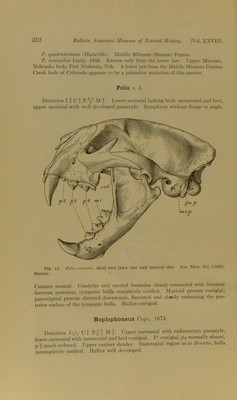
![P. qiuulridentalus (Blainville). Middle Miocene (Sansan) France. P. inlrepidus Leidy, 1858. Known only from the lower jaw. Upper Miocene, Nebraska beds, Fort Niobrara, Neb. A lower jaw from the Middle Miocene Pawnee Creek beds of Colorado appears to be a primitive mutation of this species. Felis s. 1. Dentition I C ] P ! M }. Lower sectorial lacking both metaconid and heel, upper sectorial with well developed parastyle. Symphysis without flange or angle. Fig. 12. Felis cottcolor, skull and jaws, one half natural size. Am. Mus. No. 11082. Recent. *■ Canines normal. Condylar and carotid foramina closely connected with foramen lace ruin postering, tympanic bulla completely ossified. Mastoid process vestigial; paroccipital process directed downwards, flattened and closely embracing the pos- terior surface of the tympanic bulla. Hallux vestigial. Hoplophoneus Cope, 1874. Dentition I~ C { Pf ! M {. Upper camassial with rudimentary parastyle, lower camassial with metaconid and heel vestigial. P* vestigial, p2 normally absent, p,J much reduced. Upper canines slender. Basicranial region as in Dinictis, bulla, incompletely ossified. Hallux well developed.](https://iiif.wellcomecollection.org/image/b22471686_0028.jp2/full/800%2C/0/default.jpg)