Volume 1
A manual of operative surgery / by Sir Frederick Treves.
- Sir Frederick Treves, 1st Baronet
- Date:
- 1903
Licence: Attribution-NonCommercial 4.0 International (CC BY-NC 4.0)
Credit: A manual of operative surgery / by Sir Frederick Treves. Source: Wellcome Collection.
Provider: This material has been provided by The University of Leeds Library. The original may be consulted at The University of Leeds Library.
746/808 (page 726)
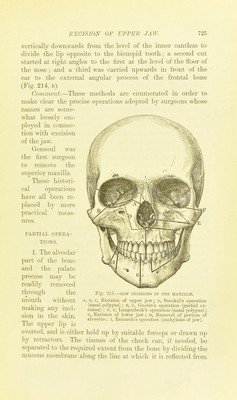
![the cheek to the mcaxilla. The division of the bone is best accompUshed by a chisel and mallet, the section being made horizontally. If the reflection of the soft parts be carried up to the level of the floor of the nares, the nasal cavity can be readily opened up from the mouth. The broad rectangular retractor used in certain abdominal operations is very useful in holding up the tissues of the cheek. 2. If it be considered desirable to remove all that portion of the superior maxilla which lies below the infraorbital foramen, the operation introduced by Guerin ( Eleuients de Chirur. Operat, Gth ed., 1881, page 2G7) may be carried out. This procedure was modified later by Maisonncuve, and is sometimes known as ]\Iaisonneuve's operation. An incision, with the convexity outwards, is made from the ala of the nose to the angle of the inouth, and is so placed as to follow the line of the features (Fig. 219, b). The soft parts are dissected up, and the nostril opened. The malar process of the superior maxilla is laid bare. A narrow saw is now introduced into the nose, and is made to saw the whole maxilla in a horizontal line. The saw-cut passes below the infraorbital canal and well above the teeth, and escapes externally through the maxillary tuberosity (Fig. 215, e). The next step is to detach the soft palate from the hard through the mouth, by means of a transverse incision made at the level of the last molar tooth. A middle incisor tooth having been removed, the hard palate is divided in the median line by a narrow saw introduced through the nose (Fig. 215, c). The piece of bone thus isolated is then loosened by an elevator and wrenched out with the lion forceps. Guerm made large use of cutting forceps, but at the present day both saw and forceps would probably be replaced by the chisel. This operation is said to have been followed by excellent results, and to have led to but little deformity. 3. If the whole of the maxilla be removed with the exception of the orbital plate, the median incision should be employed, with the omission of the horizontal suborbital part of the cut. The nasal process of the maxilla is divided close to its origin from the main bone. A horizontal cut is made with the chisel through the jaw between the orbital margin](https://iiif.wellcomecollection.org/image/b21511342_0001_0748.jp2/full/800%2C/0/default.jpg)