Licence: Public Domain Mark
Credit: How to study wild flowers / by George Henslow. Source: Wellcome Collection.
35/232 page 31
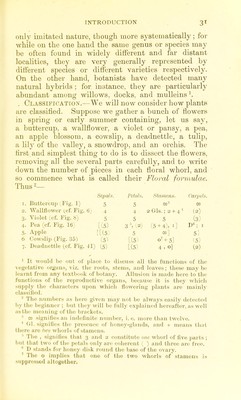
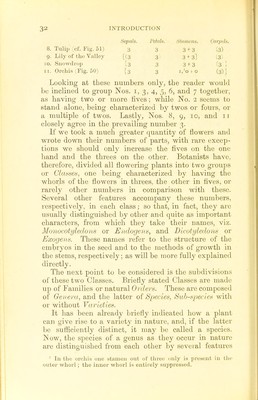
![only imitated nature, though more systematically; for while ou the one hand the same genus or species may be often found in widely different and far distant localities, they are very generally represented by different species or different varieties respectively. On the other hand, botanists have detected many natural hybrids ; for instance, they are particularly abundant among willows, docks, and mulleins ^ . Classification'.—We will now consider how plants are classified. Suppose we gather a bunch of flowers in spring or early summer containing^ let us say, a buttercup, a wallflower, a violet or pansy, a pea, an apple blossom, a cowslip^ a deadnettle, a tulip, a lily of the valley, a snowdrop, and an orchis. The first and simplest thing to do is to dissect the flowers, removing all the several parts carefully, and to write down the number of pieces in each floral whorl, and so commence what is called their Floral formulae. Thus 2— SepoHx. 1. Buttorcui) Fig. 1) 5 2. Wallllowor (cf. Fig. 6; 4 3. Violet (cf. Fig. S) 5 4. Pea (cf. Fig. 16> [(5) 5- Apple I [(5; 6 Cowslip (Fig. 35) (5I 7. Doiidiiottlo (cf. Fig. 41) (5) Petah. Stamens. Car^Jeh 5 00 4 2 Gls.; 2 + 4 ' (2) 5 5 (3) 3 '2) (5 + 4), I] D^ I 5 si [(5) o' + 5] (5) [(5) 4 , 0] (2) ' It would 1)0 out of place to discuss all the functions of the vegetative organs, viz. the roots, stems, and leaves; these maybe U'arnt from any textbook of botany. Allusion is made hero to the functions of the reproductive organs, because it is they which supply the charactei-s upon wliicli flowering i)lants are mainly classified. - Tlie nunilters as hei-e given may not be always easily detecled by the licginnei- ; but they will be fully explained hereafter, as well as the meaning of tlie brackets. ■■ CD signifies an indefinite number, i.e. moi'o tiian twelve. ' (il. signifies the presence of honey-glands, and + means (li.it there arc tiro whorls of stamens. ■ Tbe , signifies tliat 3 and 2 constitute niw whorl of five parts ; but that two of the pc^tals only are coherent { ) and three are free. D stands for honey disk round the base of the ovary. ' The o implies that one of the two whorls of stamens is suppressed altogether.](https://iiif.wellcomecollection.org/image/b21500502_0035.jp2/full/800%2C/0/default.jpg)
 No text description is available for this image
 No text description is available for this image
 No text description is available for this image