The chemistry of wheat, flour and bread and technology of breadmaking / by William Jago.
- William Jago
- Date:
- 1886
Licence: Public Domain Mark
Credit: The chemistry of wheat, flour and bread and technology of breadmaking / by William Jago. Source: Wellcome Collection.
135/538
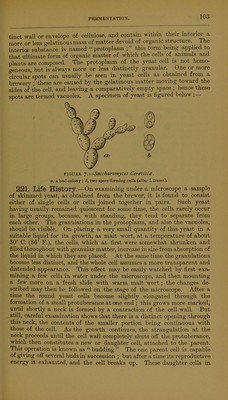
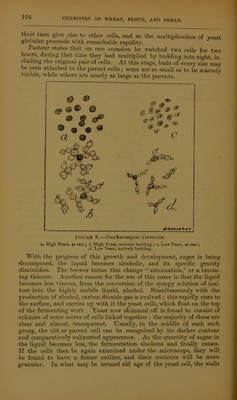
![tinct wall or envelope of cellulose, and contain within their inteiioi a more or less gelatinous mass of matter devoid of organic structure. . The interior substance is named “ protoplasm \ this term being applied to that Ultimate form of organic matter of which the cells of animals and plants are composed. The protoplasm of the yeast cell is not homo- geneous, but is always more or less distinctly granular. One or more circular spots can usually be seen in yeast cells as obtained from a brewery ] these are caused by the gelatinous matter moving toward the sides of the cell, and leaving a comparatively empty space ; hence these spots are termed vacuoles. A specimen of yeast is figured below :— 221. Life History.—On examining under a microscope a sample of skimmed yeast, as obtained from the brewer, it is found to consist either of single cells or cells joined together in pairs. Such yeast having usually remained quiescent for some time, the cells rarely occur in large groups, because, with standing, they tend to separate from each other. The granulations in the protoplasm, and also the vacuoles, should be visible. On placing a very small quantity of this yeast in a suitable liquid for its growth, as malt wort, at a temperature of about 30° C. (86° F.), the cells, which at first were somewhat shrunken and filled throughout with granular matter, increase in size from absorption of the liquid in which they are placed. At the same time the granulations become less distinct, and the whole cell assumes a more transparent and distended appearance. This effect may be easily watched by first exa- mining a few cells in water under the microscope, and then mounting a few more on a fresh slide with warm malt wort; the changes de- scribed may then be followed on the stage of the microscope. After a time the round yeast cells become slightly elongated through the formation of a small protuberance atone end ; this grows more marked, until shortly a neck is formed by a contraction of the cell Avail. But still, careful examination shows that there is a distinct opening through this neck, the contents of the smaller portion being continuous with those of the cell. As the groAvth continues, the strangulation at the neck proceeds until the cell wall completely shuts off the protuberance, which then constitutes a neAv or daughter cell, attached to the parent. This operation is knoAvn as “ budding.” The one parent cell is capable of giving ofF several buds in succession ; but after a time its reproductive energy is exhausted, and the cell breaks up. These daughter cells in FIGURE 7.—Saccharomyces Cerevisitz. a, a bud-colony : b, two spore-forming cells (after Liirssen).](https://iiif.wellcomecollection.org/image/b28125848_0135.jp2/full/800%2C/0/default.jpg)
 No text description is available for this image
 No text description is available for this image
 No text description is available for this image