The chemistry of wheat, flour and bread and technology of breadmaking / by William Jago.
- William Jago
- Date:
- 1886
Licence: Public Domain Mark
Credit: The chemistry of wheat, flour and bread and technology of breadmaking / by William Jago. Source: Wellcome Collection.
76/538
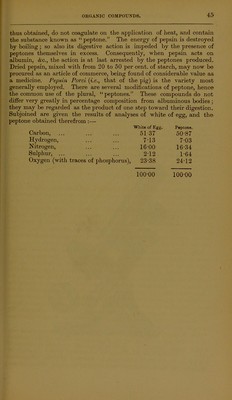
![In addition to isomerism of the above type there is yet another more striking variety. WTien distinct chemical compounds have not only the same percentage composition, but also the same molecular weight, they are said to be “ metamers,” or “ meta- meric ” with each other. As examples of metameric compounds the following three bodies maybe cited—propylamine, methylethylamine, and trimethylamine. These three bodies all have the formula, NCSH0. That they are distinct compounds containing the same proportions of carbon and hydrogen, but united together to form different organic radicals, is seen when the formulae are written as below :— (C3H. N / H (H Propylamine. The nature and constitution graph 99. (CH3 n]c2h5 [CR3 N-! CH,. CH, 1 [H Methylethylamine. Trimethylamine. of these bodies are described in para- 98. Nitrogenous Organic Bodies.—Many organic compounds, both from animal and vegetable sources, contain nitrogen as one of their constituents. Of the great majority of these bodies nothing very definite is known as to their constitution ; a large number of them are basic in their character, and hence are known as nitrogenous organic bases, or “alkaloids.” 99. Substitution, or Compound, Ammonias.—Many of the nitrogenous organic bodies are built upon the same type as ammonia, and may be viewed as ammonia in which one or more of the atoms of hydrogen are replaced by compound radicals. These compounds are termed “ amines,” or “ substitution ammonias.” The three bodies, propylamine, methylethylamine, and trimethylamine, whose formuhe are given in a preceding paragraph, are examples of amines. The methyl- amines are gases at ordinary temperatures, having a strong ammonical and fish-like smell. 100. Alkaloids.—This name is applied to a class of organic bodies, most of which contain nitrogen, carbon, hydrogen, and oxygen. All these bodies are basic, while many are able to neutralise even the strongest acids, as sulphuric acid. They are, as a class, remarkably energetic in their action on animals; thus, quinine and morphine are most powerful medicines, while strychnine and brucine are among the most violent poisons; but little is understood of the constitution of the alkaloids; it is probable that they are of the same type as the compound ammonias. For the sake of uniformity in chemical nomenclature, it lias been proposed to restrict the termination “ ine ” to the alkaloids; for this reason, glycerin, dextrin, <fcc., should never be written glycerine, dextrine, &c. 101. Pepsin and Peptones.—Pepsin is a substance which con- stitutes the active digestive principle of the fluids of the stomach (gastric juice). Pepsin is soluble in water, but insoluble in alcohol or ether. A slightly acidulated aqueous solution of pepsin, especially at the temperature of the body, rapidly dissolves insoluble albuminous substances, as the white of hard boiled eggs or lean beef. The solutions,](https://iiif.wellcomecollection.org/image/b28125848_0076.jp2/full/800%2C/0/default.jpg)