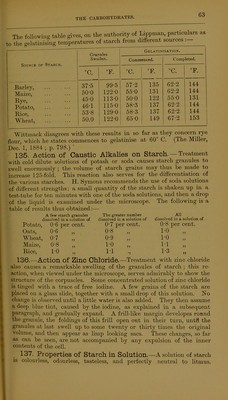
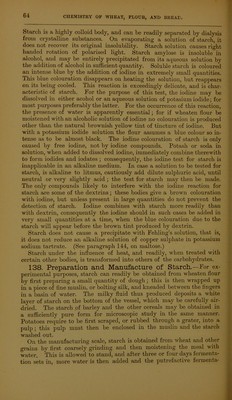
The chemistry of wheat, flour and bread and technology of breadmaking / by William Jago.
- William Jago
- Date:
- 1886
Licence: Public Domain Mark
Credit: The chemistry of wheat, flour and bread and technology of breadmaking / by William Jago. Source: Wellcome Collection.
91/538
![CHAPTER VI. THE CARBOHYDRATES. 118 Definition of “ Carbohydrate.”—This name has been applied to a class of bodies composed of carbon, hydrogen, and oxygen, in which the latter two elements are present in the same proportion as in water, namely, two atoms of hydrogen for every one of oxygen. Thus for example, starch contains to the six atoms of carbon, ten atoms of hydrogen to five atoms of oxygen. The carbohydrates comprise, among tlieir number, bodies differing considerably in physical appear- ance and character, but yet exhibiting signs of close chemical relation- ship. Subjoined is a table of the more important carbohydrates, together with their simplest possible formulae :— Cellulose, ... • • • c6h10o5. Starch, C6H10O5. Dextrin, ... C6H10O5. Maltose, ... C12H22On. Cane Sugar, Ci2H22On. Milk Sugar, C].2H22On. Glucose, or Grape Sugar, C6H1206. Cellulose, C6H10O5. 119. Occurrence and Physical Properties.—This body con- stitutes the frame-work or skeleton of vegetable organisms, in which it acts as a sort of connective tissue, binding and holding together the various parts and organs of plants. Woody fibre consists largely of cellulose and one or two closely allied substances. The pith of certain plants and also the horny part of certain seeds, as “ vegetable ivory,” are nearly pure cellulose. Manufactured vege- table fabrics, as cotton and linen goods, and likewise unsized paper, are also cellulose in an almost pure form. Chemically pure Swedish filters consist of cellulose with only the most minute traces of other bodies. Pure cellulose is white, translucent, of specific gravity of about T5, and is insoluble in water, alcohol, ether, and both fixed and volatile oils. An ammoniacal solution of copper hydrate dissolves cellulose completely; this reagent may be prepared by precipitating copper hydrate from the sulphate, by sodium hydrate, and then dissolving the thoroughly washed precipitate in strong ammonia. This solution dissolves cotton wool, or thin filtering paper, forming a sirupy solution ; on the addition of slight excess of hydrochloric acid, the cellulose is precipitated in flaky masses; these, on being washed and dried, produce a brittle horny mass. This](https://iiif.wellcomecollection.org/image/b28125848_0091.jp2/full/800%2C/0/default.jpg)