Huntington's disease / edited by Thomas N. Chase, Nancy S. Wexler, André Barbeau.
- Date:
- 1979
Licence: Attribution-NonCommercial 4.0 International (CC BY-NC 4.0)
Credit: Huntington's disease / edited by Thomas N. Chase, Nancy S. Wexler, André Barbeau. Source: Wellcome Collection.
766/856 page 734
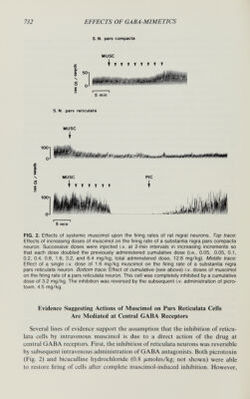
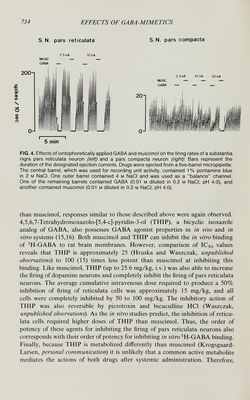
![734 EFFECTS OF GABA-MIMETICS S.N. pars reticulata S.N. pars compacta 2.5 пА 10 пА MUSC — GABA — 5 min FIG. 4. Effects of iontophoretically applied GABA and muscimol on the firing rates of a substantia nigra pars reticulata neuron (left) and a pars compacta neuron (right). Bars represent the duration of the designated ejection currents. Drugs were ejected from a five-barrel micropipette. The central barrel, which was used for recording unit activity, contained 1 % pontamine blue in 2 M NaCI. One outer barrel contained 4 м NaCI and was used as a balance channel. One of the remaining barrels contained GABA (0.01 м diluted in 0.2 м NaCI; pH 4.0), and another contained muscimol (0.01 м diluted in 0.2 м NaCI; pH 4.0). than muscimol, responses similar to those described above were again observed. 4,5,6,7-Tetrahydroisoxazolo-[5,4-c]-pyridin-3-ol (THIP), a bicyclic isoxazole analog of GABA, also possesses GABA agonist properties in in vivo and in vitro systems (15,16). Both muscimol and THIP can inhibit the in v/ira binding of 'H-GABA to rat brain membranes. However, comparison of IC50 values reveals that THIP is approximately 25 (Hruska and Waszczak, unpublished observation^ to 100 (15) times less potent than muscimol at inhibiting this binding. Like muscimol, THIP (up to 25.6 mg/kg, i.v.) was also able to increase the firing of dopamine neurons and completely inhibit the firing of pars reticulata neurons. The average cumulative intravenous dose required to produce a 50% inhibition of firing of reticulata cells was approximately 15 mg/kg, and all cells were completely inhibited by 50 to 100 mg/kg. The inhibitory action of THIP was also reversible by picrotoxin and bicuculline HCl (Waszczak, unpublished observations). As the in vitro studies predict, the inhibition of reticu¬ lata cells required higher doses of THIP than muscimol. Thus, the order of potency of these agents for inhibiting the firing of pars reticulata neurons also corresponds with their order of potency for inhibiting in vitro 'H-GABA binding. Finally, because THIP is metabolized differently than muscimol (Krogsgaard- Larsen, personal communication) it is unlikely that a common active metabolite mediates the actions of both drugs after systemic administration. Therefore,](https://iiif.wellcomecollection.org/image/b18021888_0767.JP2/full/800%2C/0/default.jpg)