Volume 1
Opus majus / edited, with introduction and analytical table by John Henry Bridges.
- Roger Bacon
- Date:
- 1897-1900]
Licence: In copyright
Credit: Opus majus / edited, with introduction and analytical table by John Henry Bridges. Source: Wellcome Collection.
Provider: This material has been provided by Royal College of Physicians, London. The original may be consulted at Royal College of Physicians, London.
138/608 (page 128)
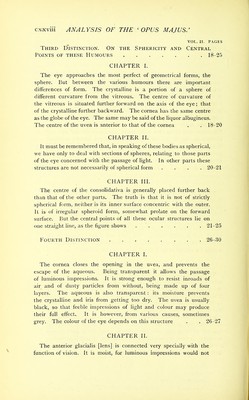
![VOL. II. PAGES Third Distinction. On the Sphericity and Central Points of these Humours 18-25 CHAPTER I. The eye approaches the most perfect of geometrical forms, the sphere. But between the various humours there are important differences of form. The crystalline is a portion of a sphere of different curvature from the vitreous. The centre of curvature of the vitreous is situated further forward on the axis of the eye; that of the crystalline further backward. The cornea has the same centre as the globe of the eye. The same may be said of the liquor albugineus. The centre of the uvea is anterior to that of the cornea . . 18-20 CHAPTER II. It must be remembered that, in speaking of these bodies as spherical, we have only to deal with sections of spheres, relating to those parts of the eye concerned with the passage of light. In other parts these structures are not necessarily of spherical form .... 20-21 CHAPTER III. The centre of the consolidativa is generally placed further back than that of the other parts. The truth is that it is not of strictly spherical form, neither is its inner surface concentric with the outer. It is of irregular spheroid form, somewhat prolate on the forward surface. But the central points of all these ocular structures lie on one straight line, as the figure shows 21-25 Fourth Distinction 26-30 CHAPTER I. The cornea closes the opening in the uvea, and prevents the escape of the aqueous. Being transparent it allows the passage of luminous impressions. It is strong enough to resist inroads of air and of dusty particles from without, being made up of four layers. The aqueous is also transparent : its moisture prevents the crystalline and iris from getting too dry. The uvea is usually black, so that feeble impressions of light and colour may produce their full effect. It is however, from various causes, sometimes grey. The colour of the eye depends on this structure . . 26-27 CHAPTER II. The anterior glacialis [lens] is connected very specially with the function of vision. It is moist, for luminous impressions would not](https://iiif.wellcomecollection.org/image/b24975655_0001_0138.jp2/full/800%2C/0/default.jpg)