Zoological philosophy / by J.B. Lamarck ; translated, with an introduction by Hugh Elliot.
- Lamarck, Jean Baptiste Pierre Antoine de Monet de.
- Date:
- 1914
Licence: In copyright
Credit: Zoological philosophy / by J.B. Lamarck ; translated, with an introduction by Hugh Elliot. Source: Wellcome Collection.
Provider: This material has been provided by Royal College of Physicians, London. The original may be consulted at Royal College of Physicians, London.
231/512 (page 135)
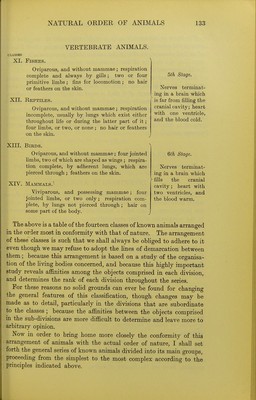
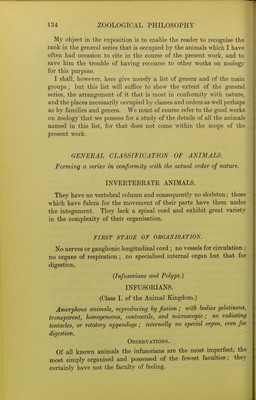
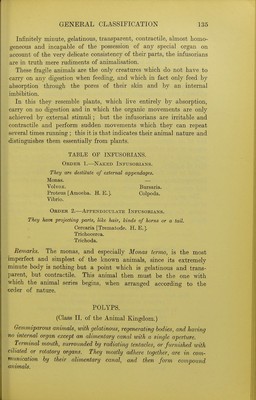
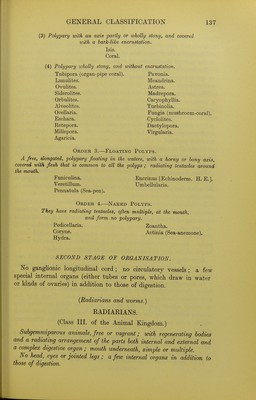
![Infinitely minute, gelatinous, transparent, contractile, almost homo- geneous and incapable of the possession of any special organ on account of the very delicate consistency of their parts, the infusorians are in truth mere rudiments of animahsation. These fragile animals are the only creatures which do not have to carry on any digestion when feeding, and which in fact only feed by absorption through the pores of their skin and by an internal imbibition. In this they resemble plants, which Hve entirely by absorption, carry on no digestion and in which the organic movements are only achieved by external stimuh ; but the infusorians are irritable and contractile and perform sudden movements which they can repeat several times running ; this it is that indicates their animal nature and distinguishes them essentially from plants. TABLE OF INFUSORIANS. Order 1.—^Nakied Infusorians. They are destitute of external appendages. Monas. — Volvox. Bursaria. Proteus [Amoeba. H. E.]. Colpoda. Vibrio. Order 2.—Appendiculate Infusorians. They have projecting parts, like hair, kinds of horns or a tail. Cercaria [Trematode. H. E.]. Trichocerca. Trichoda. Remarks. The monas, and especially Monas termo, is the most imperfect and simplest of the known animals, since its extremely minute body is nothing but a point which is gelatinous and trans- parent, but contractile. This animal then must be the one with which the animal series begins, when arranged according to the order of nature. POLYPS. (Class II. of the Animal Kingdom.) Gemmiparous animals, with gelatinous, regenerating bodies, and having no internal organ except an alimentary canal with a single aperture. Terminal mouth, surrounded by radiating tentacles, or furnished with ciliated or rotatory organs. They mostly adhere together, are in com- munication by their alimentary canal, and then form compound animals.](https://iiif.wellcomecollection.org/image/b22651433_0231.jp2/full/800%2C/0/default.jpg)