Zoological philosophy / by J.B. Lamarck ; translated, with an introduction by Hugh Elliot.
- Lamarck, Jean Baptiste Pierre Antoine de Monet de.
- Date:
- 1914
Licence: In copyright
Credit: Zoological philosophy / by J.B. Lamarck ; translated, with an introduction by Hugh Elliot. Source: Wellcome Collection.
Provider: This material has been provided by Royal College of Physicians, London. The original may be consulted at Royal College of Physicians, London.
232/512 (page 136)
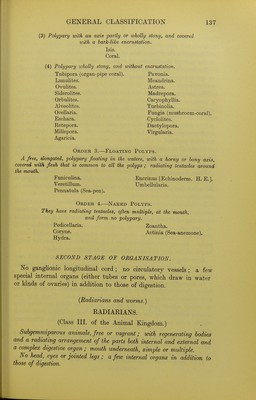
![Observations. We have seen that the infusorians are infinitely small and fragile animalcules without coherence, without a shape peculiar to their class, without any organs and hence without a distinct mouth and alimentary canal. In the polyps the simphcity and imperfection of organisation, although very conspicuous, are less than in the infusorians. Organisa- tion has clearly made some progress ; for nature has already obtained a permanent and regular shape for the animals for this class; they are all provided with a special organ for digestion, and consequently with a mouth which leads into the aUmentary sac. Imagine a small, elongated gelatinous, highly irritable body, which has at its superior extremity a mouth furnished either with rotatory organs or with radiating tentacles serving as the entrance to an ahmen- tary canal which has no other opening: and we shall have a good idea of a polyp. Add to this that many of these httle bodies become adherent and Hve together in a common life, and we shall then know the most general and curious fact that concerns them. The polyps are more imperfect in organisation than the animals of the following classes, since they have no nerves for feehng, no special organs for respiration and no vessels for the circulation of their fluids. TABLE OF POLYPS. Order 1.—Rotifer Polyps. They have ciliated and rotatory organs at their mouths. Urceolaria. Brachionus (?). Vorticella [Infusorian. H. E.]. Order 2.—Polyps which form Polyparies. [Hydrozoa, Aathozoa, Polyzoa, Sponge, etc. H. E. ] They have radiating tentacles around the mouth, and are fixed in a polypary which does not float upon the waters. (1) Polypary membranous or horny, without distinct bark. Cristatella. Cellaria. Plumatella. Flustra. Tubularia. Cellepora. Sertularia. Botryllus [Ascidian. H. E.]. (2) Polypary with a horny axis, covered with an encrustation. Acetabulum [Alga. H. E.]. Alcyon. Corallina [Alga. H. E.]. Antipathes (black coral). Gorgonia (sea-fan). Sponge.](https://iiif.wellcomecollection.org/image/b22651433_0232.jp2/full/800%2C/0/default.jpg)