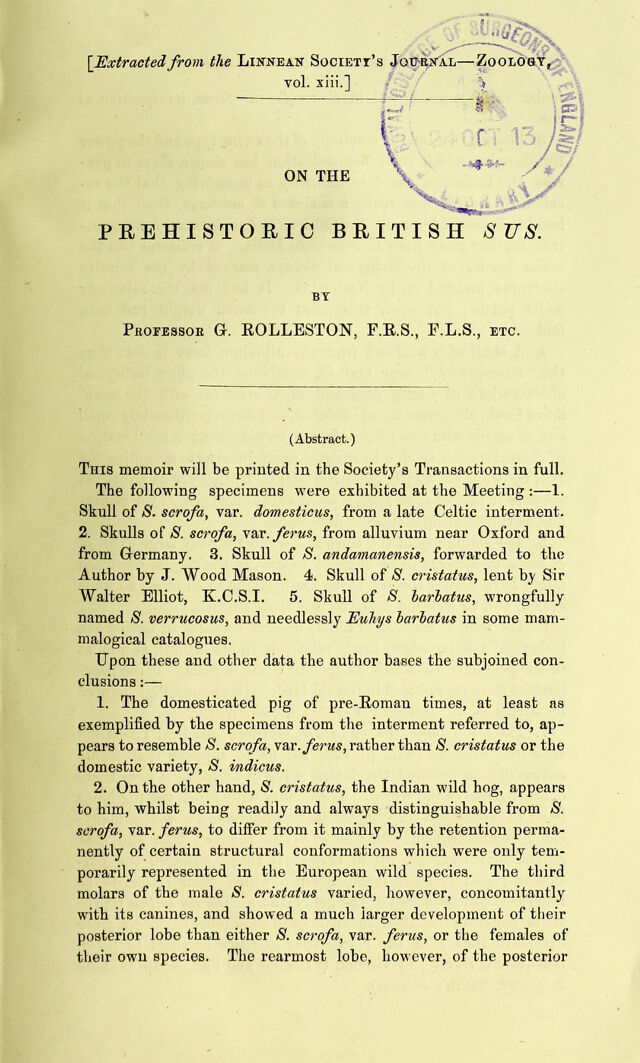
On the domestic pig of prehistoric times in Britain, and on the mutual relations of this variety of pig and Sus scrofa ferus, Sus cristatus, Sus andamanensis, and Sus barbatus / by George Rolleston.
- George Rolleston
- Date:
- 1876
Licence: Public Domain Mark
Credit: On the domestic pig of prehistoric times in Britain, and on the mutual relations of this variety of pig and Sus scrofa ferus, Sus cristatus, Sus andamanensis, and Sus barbatus / by George Rolleston. Source: Wellcome Collection.
Provider: This material has been provided by The Royal College of Surgeons of England. The original may be consulted at The Royal College of Surgeons of England.
5/48
![[^Extracted from the ‘Teausactioks of the LiNifB*N;Sbci]^ 0/London,’ Second Series,—Zoology, toI. i.] XIII. On the Domestic Dig of Drehistoric Times in Britain, and on the mutual Delations of this variety of Dig and Sus scrofa ferus, Sus cristatus, Sus andamanensis, and Sus barbatus. By George Rolleston, M.D., F.D.S., F.B.S., Binacre Drofessor of Anatomy and Fhysiology, Oxford, (Plates XLI.-XLIII.) Read June 15th, 1876. Portions of two skeletons of domestic pigs having been put into my hands by the Rev. William Greenwell, P.S.A., from an interment of the so-called late Celtic period, i. e. of the ultimate or penultimate century before the Roman conquest of this country, I determined to compare them with such other specimens of Suidce as might by any possibility be genetically connected with them. Among these other specimens I may mention, first, several specimens of the Wild Boar, Sus scrofa, ferus, from the alluvial deposits of this neighbourhood, and now in the Geological Series of the Oxford Museum, under the charge of Professor Prestwich, P.R.S.; secondly, five specimens of the Indian Wild Hog, Sus cristatus, kindly lent me by Sir Walter Elliot, K.C.S.I., E.L.S.; thirdly, two skulls of Sus andamanensis, presented to the Oxford University Museum by my friend Prof. J. Wood-Mason, of the Indian Museum, Calcutta; and fourthly, four skulls of Sus barbatus from Borneo. The extensive series of skulls of Suidse contained in the British Museum, those in tlie Royal College of Surgeons of London, and the specimens of wild- and domestic-swine skulls contained in our own collection were also used for this comparison. It may be well at the outset to specify the several points of wide and general interest upon which such an inquiry as the ensuing may be brought to bear. Eirst among these I would mention its bearings upon the now so commonly discussed questions relating to the early migrations of our own species. The pig was one of the earliest, possibly the very earliest, of animals which man domesticated; and the question of the source or sources whence it was derived has consequently an “ethnographisch-archseologische Bedeu- tung” (to use the words of Eischer *, in his analogous investigation as to the sources whence the jade and nephrite of early European times were procured) of the first import- ance. Gibbon f has remarked that “ man is the only animal which can live and multiply in every country from the equator to the polesand he has proceeded to aver that “ the hog seems to approach nearest to our species in that privilege.” As a matter of fact. Gibbon here, as so often elsewhere, was very nearly though not quite exact: the north- ward limit of the range of the Wild Boar may perhaps be taken as somewhere between * H. Fischer, ‘ Xephrit und Jadeit naeh ihren mineralogischen Eigenschaften.’ Stuttgart, 1875. For similar investigations as to the sources of the cultivated plants and the weeds of prehistoric times, see Keller’s ‘ Lake- Dwellings,’ translated by Lee, pp. 303 and 343. t ‘ Decline and Fall of the Roman Empire,’ chap. ix. note 9, p. 352. Smith’s edition.](https://iiif.wellcomecollection.org/image/b22463471_0007.jp2/full/800%2C/0/default.jpg)