Every child matters : ninth report of session 2004-05. Volume 1, Report together with formal minutes.
- Great Britain. Parliament. House of Commons. Education and Skills Committee
- Date:
- 2005
Licence: Open Government Licence
Credit: Every child matters : ninth report of session 2004-05. Volume 1, Report together with formal minutes. Source: Wellcome Collection.
62/84 page 58
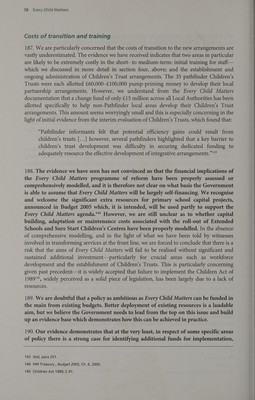
![Costs of transition and training 187. We are particularly concerned that the costs of transition to the new arrangements are vastly underestimated. The evidence we have received indicates that two areas in particular are likely to be extremely costly in the short- to medium-term: initial training for staff— which we discussed in more detail in section four, above; and the establishment and ongoing administration of Children’s Trust arrangements. The 35 pathfinder Children’s Trusts were each allotted £60,000—-£100,000 pump-priming money to develop their local partnership arrangements. However, we understand from the Every Child Matters documentation that a change fund of only £15 million across all Local Authorities has been allotted specifically to help non-Pathfinder local areas develop their Children’s Trust arrangements. This amount seems worryingly small and this is especially concerning in the light of initial evidence from the interim evaluation of Children’s Trusts, which found that: “Pathfinder informants felt that potential efficiency gains could result from children’s trusts [...] however, several pathfinders highlighted that a key barrier to children’s trust development was difficulty in securing dedicated funding to adequately resource the effective development of integrative arrangements.”!” 188. The evidence we have seen has not convinced us that the financial implications of the Every Child Matters programme of reform have been properly assessed or comprehensively modelled, and it is therefore not clear on what basis the Government is able to assume that Every Child Matters will be largely self-financing. We recognise and welcome the significant extra resources for primary school capital projects, announced in Budget 2005 which, it is intended, will be used partly to support the Every Child Matters agenda.'* However, we are still unclear as to whether capital building, adaptation or maintenance costs associated with the roll-out of Extended Schools and Sure Start Children’s Centres have been properly modelled. In the absence of comprehensive modelling, and in the light of what we have been told by witnesses involved in transforming services at the front line, we are forced to conclude that there is a risk that the aims of Every Child Matters will fail to be realised without significant and sustained additional investment—particularly for crucial areas such as workforce development and the establishment of Children’s Trusts. This is particularly concerning given past precedent—it is widely accepted that failure to implement the Children Act of 1989'*°, widely perceived as a solid piece of legislation, has been largely due to a lack of resources. 189. We are doubtful that a policy as ambitious as Every Child Matters can be funded in the main from existing budgets. Better deployment of existing resources is a laudable aim, but we believe the Government needs to lead from the top on this issue and build up an evidence base which demonstrates how this can be achieved in practice. 190. Our evidence demonstrates that at the very least, in respect of some specific areas of policy there is a strong case for identifying additional funds for implementation, 143 ibid, para 251. 144 HM Treasury , Budget 2005, Ch. 6. 2005. 145 Children Act 1989, C.41.](https://iiif.wellcomecollection.org/image/b3222266x_0062.jp2/full/800%2C/0/default.jpg)



 No text description is available for this image
 No text description is available for this image
 No text description is available for this image