The spleen and some of its diseases : being the Bradshaw lecture of the Royal college of surgeons of England, 1920 / by Sir Berkeley Moynihan.
- Berkeley Moynihan
- Date:
- 1921
Licence: In copyright
Credit: The spleen and some of its diseases : being the Bradshaw lecture of the Royal college of surgeons of England, 1920 / by Sir Berkeley Moynihan. Source: Wellcome Collection.
155/176 (page 115)
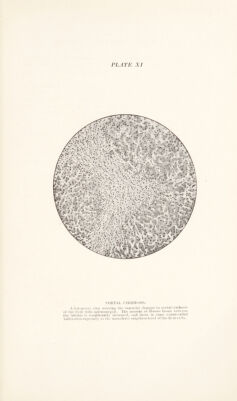
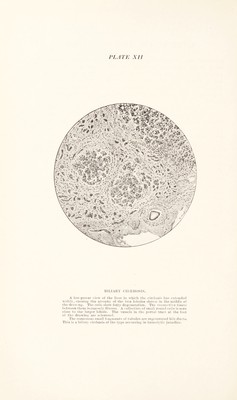
![eanaliculi are obstructed, a diffuse intralobular cirrhosis develops ; when larger ones are involved, the cirrhosis is of a pure mono- lobular form; when the largest channels are involved, stellate lesions result. In all cases an obstruction to the hepatic veins ultimately occurs, and the changes of chronic passive congestion supervene, with the usual clinical phenomena aroused by such a condition. The work of these two investigators indicates that the problem of cirrhosis is rather one of vascular supply than of biliary outflow. They conclude that the character of the bile does not play a notable part in the production of cirrhosis ; that stagnation of bile is secondary to changes in the liver-cells ; and that infection of the stagnated bile—an event very prone to occur—is the last step in the history of biliary cirrhosis. In other words, biliary cirrhosis develops in increasing amount during the progress of the following four steps : first an interference with vascular supply; then derangement of function of liver cells ; then modification of the character of the bile; and finally infection of the bile. These conclusions bring the portal and biliary types of cirrhosis together, and do not exclude the type associated with passive congestion due to cardiac disease. In this respect they accoid with the views expressed by W. J. Mayo*, whose studies have led him to believe that there is no essential difference between the Laennec type and the biliary type of cirrhosis. In the case of the former, however, he places much weight on the importance of the circulatory disturbances ; in the Hanot type, on infectious agents. The associated enlargement of the spleen may be mechanical in the one, by introducing circulatory distress to an organ already hampered by stagnant blood; and causative in the other, by harbouring micro-organisms which are passed on to the liver. In either case the response by the liver is in the form of cirrhosis. Its anatomical form is simply the outcome of a combination of the two factors in varying proportions. The more extensive the infection, the more mixed the type of cirrhosis. The view that the source of biliary cirrhosis is an infection ascending the bile-ducts is supported by Rosenow’s observation*]* that streptococci occur, not in the bile, but in the walls of the gall- * Jour. Amer. Med. Assoc. 1918, May, Ixx, 1361. f Jour, of Infect. Dis. 1916, 19, 527.^](https://iiif.wellcomecollection.org/image/b29928874_0155.jp2/full/800%2C/0/default.jpg)